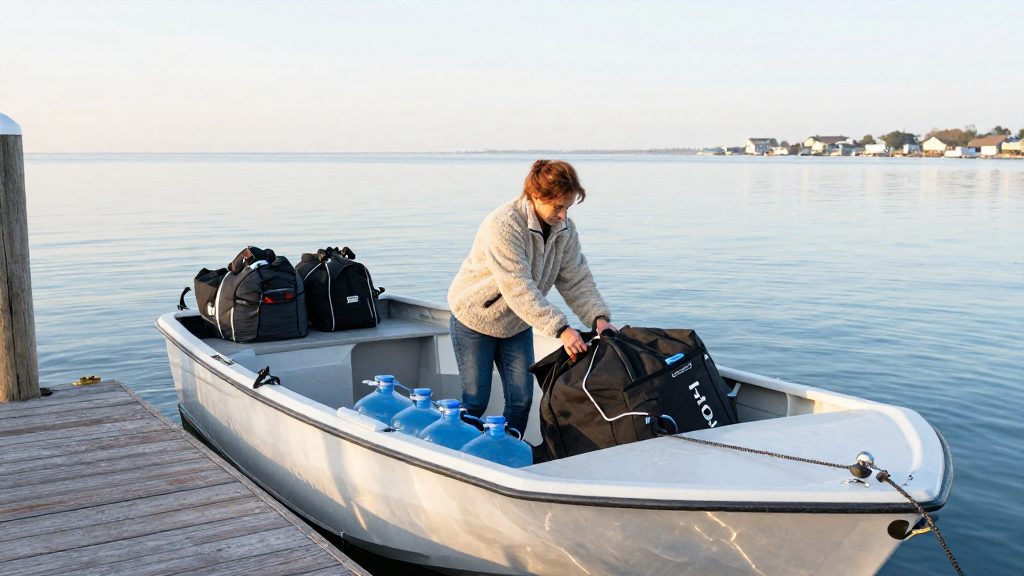
A multi-day boat trip on the Great Lakes is manageable when four things are settled before you leave the dock: everyone who steers holds acceptable proof of competency, the boat carries the safety equipment its length requires, you can read the marine forecasts issued for these waters, and each day’s leg ends at a sheltered place you can reach safely. The rules in this article are Canadian federal rules that apply while you are in Canadian waters. If your route enters United States waters, the rules of that country apply there and are not covered here.
Do you need proof of competency to steer the boat?
Under Transport Canada rules, anyone operating a motorized recreational boat in Canada must have proof of competency on board. This includes boats fitted with electric trolling motors, and it applies even when the motor is not running, for example when you are sailing. Because the duty falls on the operator, check the credentials of every person who takes a turn at the helm, not only the skipper’s.
The accepted proofs are a Pleasure Craft Operator Card (PCOC), a boating course certificate completed before April 1, 1999, an accepted professional marine certificate, or a rental boat safety checklist valid for the rental period. A paper or electronic copy of a PCOC is not accepted, so carry the card itself. Visitors may use a document that meets the requirements of their home jurisdiction. Two exemptions matter for a trip like this: the waters of Nunavut and the Northwest Territories, and a visitor operating a boat brought into Canada for fewer than 45 consecutive days. Once the boat has been in Canada for 45 consecutive days or more, that visitor exemption no longer applies.
What safety equipment does your boat need?
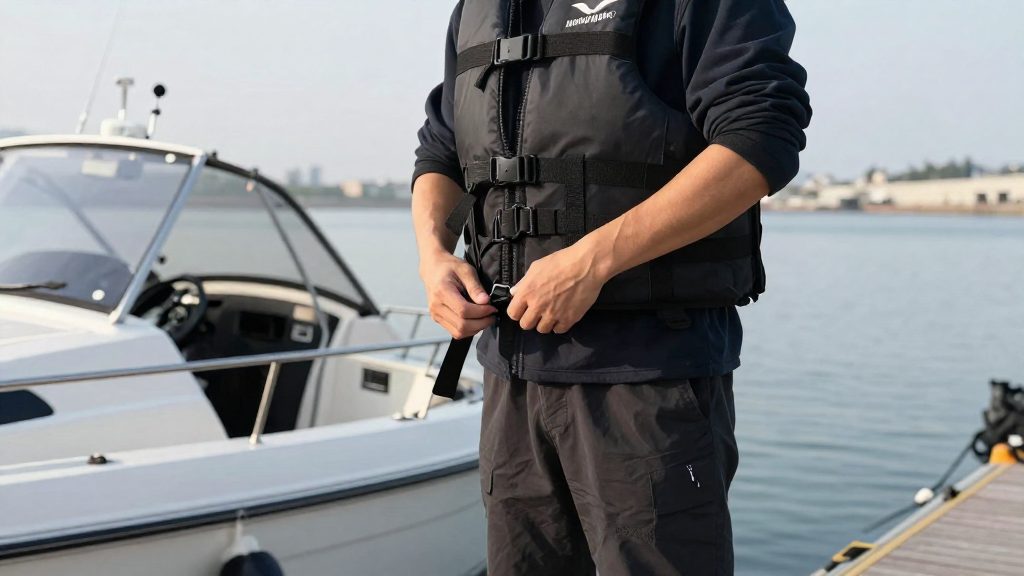
The lists depend on the length of the boat and, for some items, on its power and fuel system. They are set out in Part 2 of the Small Vessel Regulations (SOR/2010-91), published by the Government of Canada on Justice Laws. The points below cover boats up to 9 metres, a common size for Great Lakes cruising. Check the full tables for larger craft.
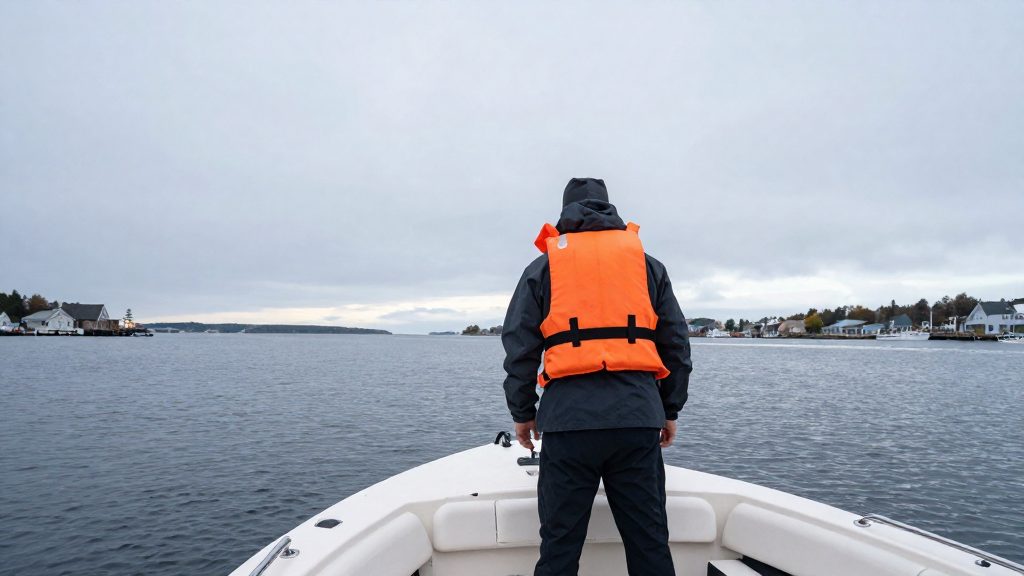
- Personal flotation devices: one appropriately sized PFD or lifejacket for each person aboard, plus a reboarding device unless the climb from the water is 0.5 metres or less. A PFD worn by anyone under 16 must be inherently buoyant.
- Throwing equipment: on boats up to 6 metres, a buoyant heaving line of at least 15 metres. On boats from 6 to 9 metres, a heaving line or a lifebuoy on a buoyant line, each at least 15 metres long.
- Visual distress signals: on boats up to 6 metres, a watertight flashlight or three pyrotechnic distress signals. Pyrotechnic signals expire four years after manufacture.
- Vessel safety: either a manual propelling device or an anchor with at least 15 metres of cable, rope or chain, plus a bailer or manual bilge pump. A bailer must hold at least 750 mL and have an opening of at least 65 cm².
- Navigation: a sound-signalling device, a magnetic compass, and navigation lights that meet the Collision Regulations, required after sunset, before sunrise or in restricted visibility.
- Firefighting: a 5B:C portable extinguisher on boats up to 6 metres that have an inboard engine, a fixed fuel tank, or a fuel-burning cooking, heating or refrigeration appliance. The extinguisher must not weigh more than 23 kg and must carry a product certification mark or United States Coast Guard approval.
Before departure, check PFD condition and expiry dates, flare dates, bailer and anchor line, and extinguisher pressure. Stow equipment where a crew member can reach it in the dark, not in a locker that needs to be emptied to access it.
How do you read Great Lakes marine forecasts?
Environment and Climate Change Canada issues the marine forecasts for these waters, and the product you need depends on the question you are asking. The Regular marine forecast is issued at 3:00, 10:30 and 18:30 local time and covers the current day and the next day. The Wave Height Forecast uses the same three issue times and gives significant wave height in metres for the same two days, so use it to judge sea state. The Extended Forecast, issued at 3:00 and 18:30, covers days 3 to 5 but gives only a general description of wind. It cannot tell you how large the waves will be.
For a multi-day plan, one distinction matters. The Recreational Boating Marine Forecast is issued at 5:00, 11:30 and 17:00, but it covers only smaller Ontario waters such as Lake Simcoe, Lake Nipissing, the North Channel of Lake Huron, Lake Nipigon and Lake of the Woods. It is not issued for the Great Lakes proper. It runs only from May 1 to November 30 and carries no wave heights, so it cannot replace the Regular or Wave Height forecasts on the open lakes.
Localized warnings and watches are issued as separate bulletins. Apart from the High Water Level Warning, they are not part of the Regular marine forecast, so check them on their own before you leave each morning. The forecasts are broadcast on the Canadian Coast Guard Continuous Marine Broadcast on VHF radio, and current wind, wave and visibility observations from buoy and land stations are available online.
How do you plan daily legs around the weather?
Plan each leg with alternatives rather than a single line on the chart. For each day, choose a primary harbour and at least one alternative that you can reach in the conditions you would be willing to run in. Calculate fuel for each leg from the engine manufacturer’s consumption data for your boat, and set a reserve in advance rather than discovering it at the fuel dock. Carry current charts and a backup for your electronic navigation, so that a failed screen does not leave you without a position.
Build a spare day into the itinerary. A trip with no slack pushes crews to run in marginal conditions to stay on schedule. Set a departure window using the Regular forecast and the Wave Height Forecast for the current day and the next day. Treat the Extended Forecast as a reason to prepare for a change in conditions, not as a basis for a firm departure.
When should you shelter or cancel a leg?
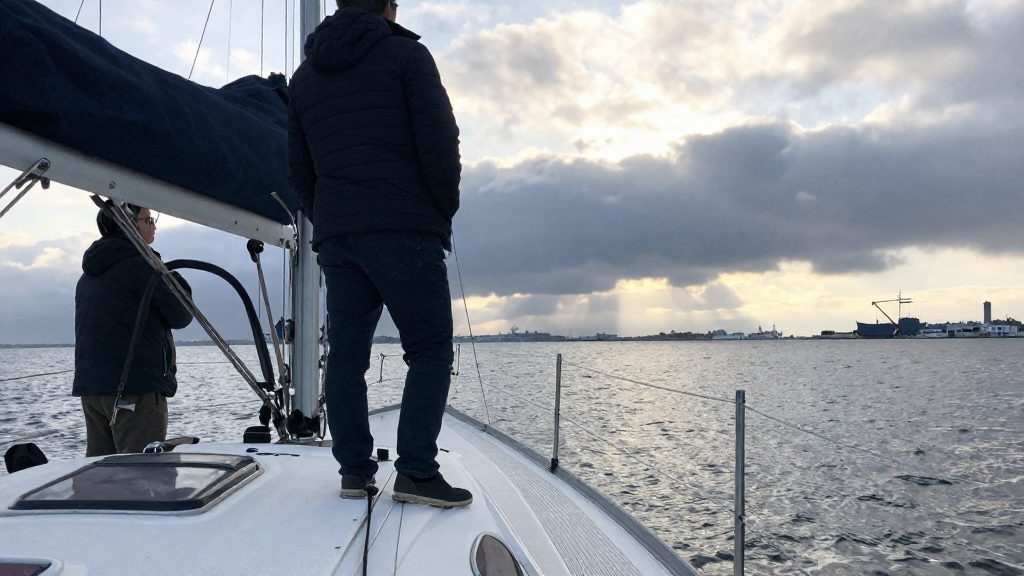
Wind warnings are flagged in the Regular Forecast against fixed thresholds. Strong wind is 20 to 33 knots and is issued from May 1 to November 30. Gale is 34 to 47 knots, storm is 48 to 63 knots, and hurricane force is 64 knots or more. Do not start a leg into a gale warning. Under a strong wind warning, reassess the leg before you leave and stop early unless the route is short and sheltered.
The thresholds are warning levels, not limits for your boat. The manufacturer’s documentation for your model states its operating conditions, and a smaller boat or a less experienced crew may need to stop well below those levels. If conditions build during a leg, make for the nearest sheltered harbour rather than the planned destination, even if that means abandoning the day’s distance.
Why file a float plan and keep radio contact?
A float plan is a written record left with someone ashore. Include the names and contact details of everyone aboard, a description of the boat with its registration and colour, the route with planned overnight stops, and the expected arrival time at each. Name the person who will raise the alarm if you are overdue, and agree on the time they will do so. Update the plan when your intentions change, and close it as soon as you are safely ashore at the end of the trip.
A VHF radio is your main link to the Canadian Coast Guard broadcast and to other vessels and rescue services in an emergency. Learn how to send a distress call on your set and practise it before you need it. Know which channels your set uses for the broadcasts you intend to monitor.
What changes when you cross the border by boat?
Private pleasure craft arriving in Canada must report by telephone to the Canada Border Services Agency (CBSA), under memorandum D2-5-12 dated June 25, 2025, which supersedes the version dated May 13, 2025. On arrival, the operator must immediately call the Telephone Reporting Centre at 1-888-226-7277. The boat must dock at an approved telephone reporting site during normal business hours, unless the local CBSA office has made other arrangements. If the toll-free line is unavailable, the memorandum gives 905-679-2073, though long-distance charges may apply. Only the operator may leave the boat to report. Passengers must stay aboard until the Telephone Reporting Centre or a CBSA verification officer authorizes them to disembark, and the boat and everyone aboard must remain at the arrival point until notified.
NEXUS members who want expedited service must call 1-866-996-3987 at least 30 minutes and no more than four hours before the estimated arrival time. Expedited service applies only if everyone aboard is a NEXUS participant. The telephone reporting procedure covers private boats carrying 29 or fewer passengers, including the crew. The operator can be held liable for the removal of inadmissible passengers and for related expenses, so confirm the admissibility of everyone aboard before you cross.
Frequently asked questions
Is a float plan a legal requirement in Canada?
The official sources consulted for this article do not list a float plan as a legal requirement. It is a recommended practice that helps search teams if you are overdue.
Does a Canadian Pleasure Craft Operator Card apply in United States waters?
The official sources consulted for this article do not address whether a Canadian card is recognized in United States waters. Check United States requirements before you enter those waters.
Do paddleboards and rowboats need the same equipment as motorized boats?
No. The lists above apply to pleasure craft other than human-powered craft. Human-powered craft have separate provisions in Part 2 of the Small Vessel Regulations, which this article does not summarize.