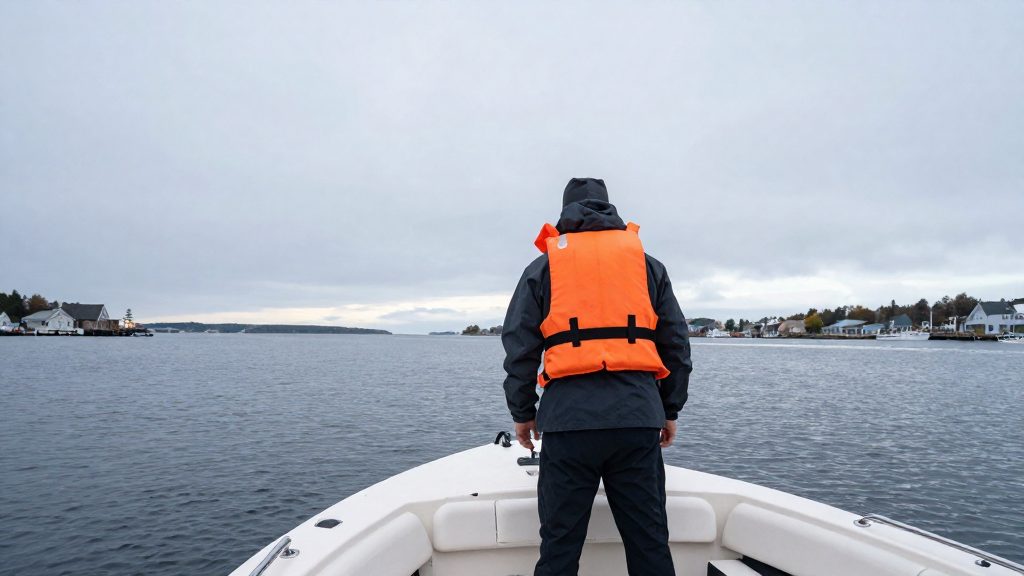
In Canada, the federal Small Vessel Regulations require a pleasure craft to carry a personal flotation device (PFD) or lifejacket of an appropriate size for each person on board. In the sections consulted, that is a carrying obligation rather than a general duty to wear the device at all times. Several rules, however, depend on wearing, and Transport Canada’s guidance is clear that equipment only protects you when it is worn. This guide explains what the federal rules require, when wearing becomes a condition, how children and visitors are treated, and how to check fit and condition before you leave the dock.
What do the federal rules require on board?
Section 204 of the Small Vessel Regulations requires a pleasure craft, other than a human-powered one, to carry a PFD or lifejacket of an appropriate size for each person on board (Justice Laws Website, Government of Canada, 2026). The obligation counts people, not seats. A guest, a child or a crew member who joins for part of the day needs a device of their own. The text consulted does not translate appropriate size into weight or chest ranges, so the manufacturer’s sizing table is the reference for choosing each device, and the fit checks later in this guide confirm it on the person.
Human-powered craft fall under section 209, which requires each person on board to have an appropriately sized device (Justice Laws Website, Government of Canada, 2026). If the craft is used in whitewater, the device itself must be inherently buoyant, meaning it floats without needing to be inflated. Canoes, kayaks and rowboats used on flatwater therefore follow the sizing rule, while whitewater use adds the buoyancy requirement.
Why should you wear the device if the law only requires carrying it?
Transport Canada’s guidance on choosing lifejackets and PFDs states that lifesaving equipment must be worn at all times to work. It also notes that most recreational boaters who die on the water each year in Canada are not wearing a flotation device, or are not wearing it properly. A device stowed under a seat or in a locker cannot protect a person who falls overboard. In adverse conditions, putting a PFD on in the water can be extremely difficult or impossible. The same guidance states that a lifejacket is the best defence against cold-water shock, because it gives thermal protection as well as buoyancy, which PFDs usually do not provide to the same degree. Wearing is therefore the practical standard, even where the law does not spell it out.
Lifejacket or PFD: which one should you choose?
A lifejacket and a PFD both provide flotation, but they differ in how much buoyancy they give and how they position an unconscious person. According to Transport Canada, lifejackets provide more flotation in water than most PFDs. A PFD usually offers less flotation and has limited ability to turn you in the water. SOLAS-type and Standard-type lifejackets turn you onto your back in seconds, while Small Vessel lifejackets do so more slowly. Choose the type that matches your activity and the conditions you expect, not the one that is simply easiest to wear.
Look for a label showing approval by Transport Canada, the Canadian Coast Guard or Fisheries and Oceans Canada. Sizing also depends on type. Transport Canada reports that SOLAS-type and Standard-type lifejackets come in two sizes, divided at 32 kg (70 lb) and 40 kg (88 lb), while Small Vessel lifejackets come in three sizes. Check the label and the manufacturer’s sizing table before you buy or lend a device.
How do the rules apply to children and small passengers?
Section 202 sets a specific rule for children. A PFD or lifejacket that must be carried on board, and that a person under 16 is to wear, must be inherently buoyant (Justice Laws Website, Government of Canada, 2026). Each child therefore needs a suitable device of their own, and that device must float without relying on inflation. Transport Canada’s guidance adds that inflatable PFDs are prohibited for people under 16 or under 36.3 kg (80 lb).
Fit matters as much as type. A child’s device should sit snugly and must not ride up over the chin or ears. Transport Canada advises that there should be less than 7.6 cm (3 in.) between the child’s shoulders and the device. If a device rides up or gaps at the shoulders when the child moves, it is the wrong size or the wrong type for that child.
When can the reduced equipment rules apply?
Some craft may carry a reduced list of safety equipment, but only when the people concerned are wearing a device. Sections 218 to 220 of the Small Vessel Regulations set out three cases (Justice Laws Website, Government of Canada, 2026).
- Personal watercraft: every person on board must wear a device of an appropriate size (s. 218). The reduced list then covers a sound-signalling device, a watertight flashlight or three pyrotechnic distress signals (no more than one of them a smoke signal), a magnetic compass if you navigate out of sight of seamarks, and navigation lights if you operate after sunset, before sunrise or in restricted visibility.
- Sailboards and kiteboards: the operator must wear a device of an appropriate size (s. 219). The reduced list is a sound-signalling device and, in low light or restricted visibility, a watertight flashlight.
- Paddleboats, watercycles, stand-up paddleboards and sealed-hull sit-on-top kayaks: every person on board must wear a device of an appropriate size (s. 220). The reduced list is a sound-signalling device and, after dark or in restricted visibility, a watertight flashlight.
The wearing condition is the key point. If a person who must wear a device takes it off, the reduced list no longer applies, so check the full requirements for that craft before continuing. A reduced list never removes the need for a device on board.
Can visitors use their own lifejackets?
Yes, within limits. Section 212 allows a non-Canadian resident to bring their own device, provided it conforms to the laws of their country, is of an appropriate size and is in good condition. In that case, the craft is not required to carry a device meeting the Regulations for that person (Justice Laws Website, Government of Canada, 2026). The exception is narrow. It covers the carrying obligation for that person only, and it depends on the device meeting the home-country law. Visitors should check the device’s label and condition before the trip. A device that does not fit or is damaged does not meet the exception, and the person should be given a suitable device aboard.
What could the wear consultation change?
Transport Canada consulted the public from 30 August to 29 October 2024 on making PFDs or lifejackets mandatory for individuals on board recreational vessels. It also asked which factors most affect recreational boating deaths and what other actions could reduce them (Transport Canada, 2024). The consultation page is now marked closed and reports no outcome or decision. Its related documents are a background report and a study of recreational boating fatalities from 2008 to 2017, which are not results of the consultation. Until the Regulations change, the carrying rule in section 204 remains the federal baseline in the sections consulted. Watch for an official announcement, and treat wearing as the safe default in the meantime.
How do you check fit and condition before each trip?
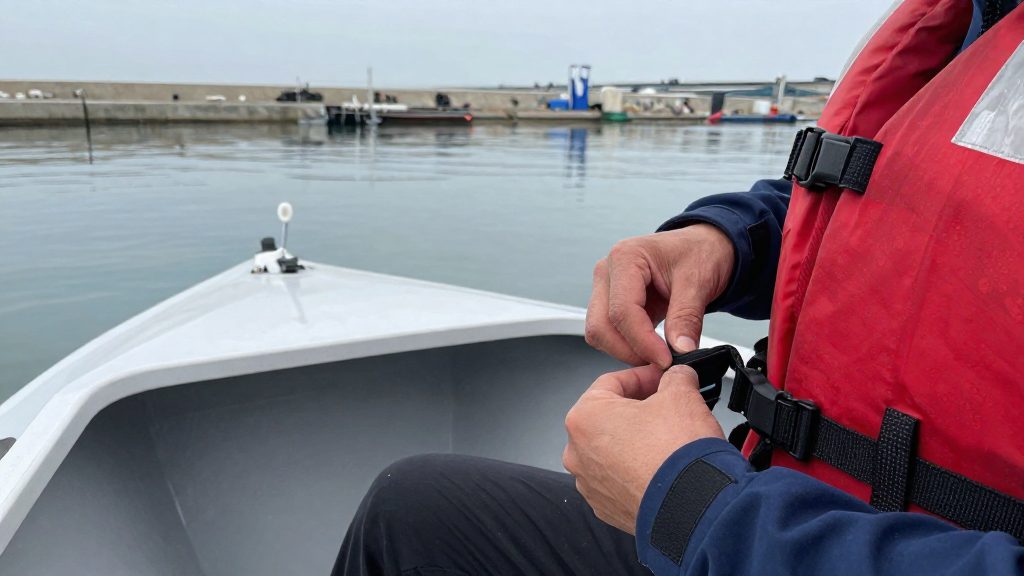
Check each device on each person, rather than counting devices. Put the device on, close every fastening, and confirm that it stays in place when you move and reach. Transport Canada advises that a device should fit snugly and must not ride up over the chin or ears. Check buoyancy regularly. Transport Canada suggests wading into waist-deep water and bending your knees, which should be done in calm, supervised conditions.
Replace any device that is ripped or in poor condition, because Transport Canada notes that such a device is not considered approved. Never kneel on it, sit on it or use it as a fender, since these habits damage the flotation. Take out of service any device that has been used hard or damaged until its condition has been checked, and follow the manufacturer’s documentation for inflation components and servicing.
Frequently asked questions
How long do lifejackets and PFDs last, and do inflatable models need servicing?
The official sources consulted do not give expiry dates or service intervals. Follow the manufacturer’s documentation for inflation components, servicing and replacement, and retire any device that shows damage.
Do provincial or territorial rules add to the federal requirements?
The federal Small Vessel Regulations set the rules described here. The official sources consulted do not list provincial or territorial rules, so check the boating rules of the province or territory where you boat, as well as any local rules for the waters you use.
How should I store devices so they are ready to use?
The official sources consulted do not address storage. As general practice, keep devices dry and where each person can reach them quickly, and check them after storage, following the manufacturer’s documentation.