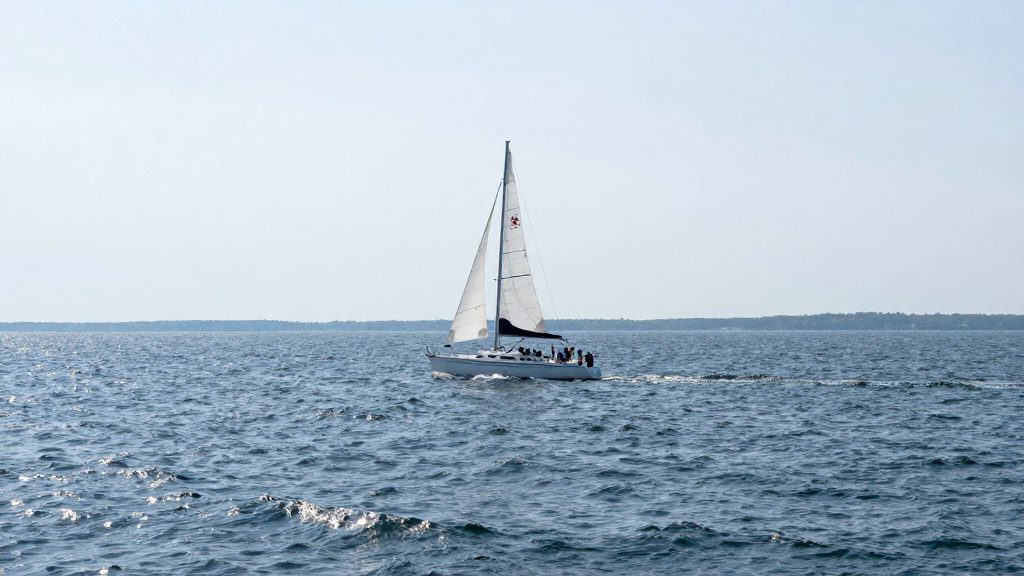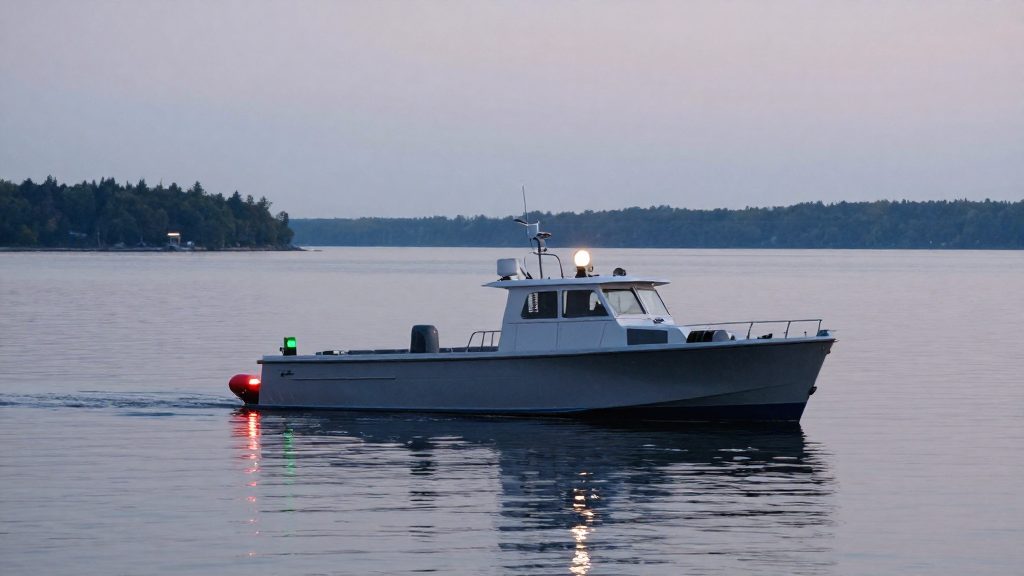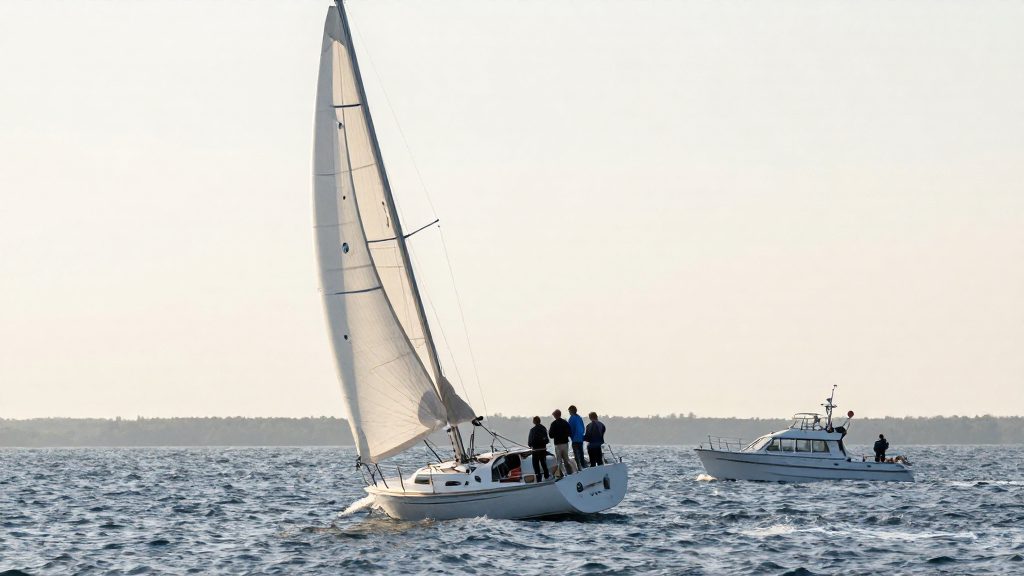
In Canada, the rules that decide who keeps out of the way between sailboats and power boats are the Collision Regulations (C.R.C., c. 1416), which reproduce the international rules with Canadian modifications. In short, a power-driven vessel underway keeps out of the way of a sailing vessel. Between two sailboats, the one with the wind on its port side keeps out of the way. Between two power boats, the vessel that has the other on its starboard side gives way in a crossing, and both alter course to starboard in a head-on meeting. These rules are duties to avoid collision, not a guarantee that you may keep your course, so read the situation before relying on them.
Which rules apply on Canadian waters?
The Collision Regulations are the federal rules of navigation in Canada. The official text, published by the Department of Justice on the Justice Laws Website, is the Schedule 1 version of the international rules, with the Canadian modifications written into the numbered rules. The rules are written for all vessels, so they apply to a small recreational boat as much as to a large freighter, wherever the two meet on Canadian navigable waters.
The Canadian modifications matter in specific places, especially rivers. A boater who knows only a general international summary may miss them, so the Canadian text is the one to read. Reading the rule numbers cited in this article against that text will help you check any detail before you rely on it.
Why do the give-way and stand-on roles matter more than the phrase right of way?
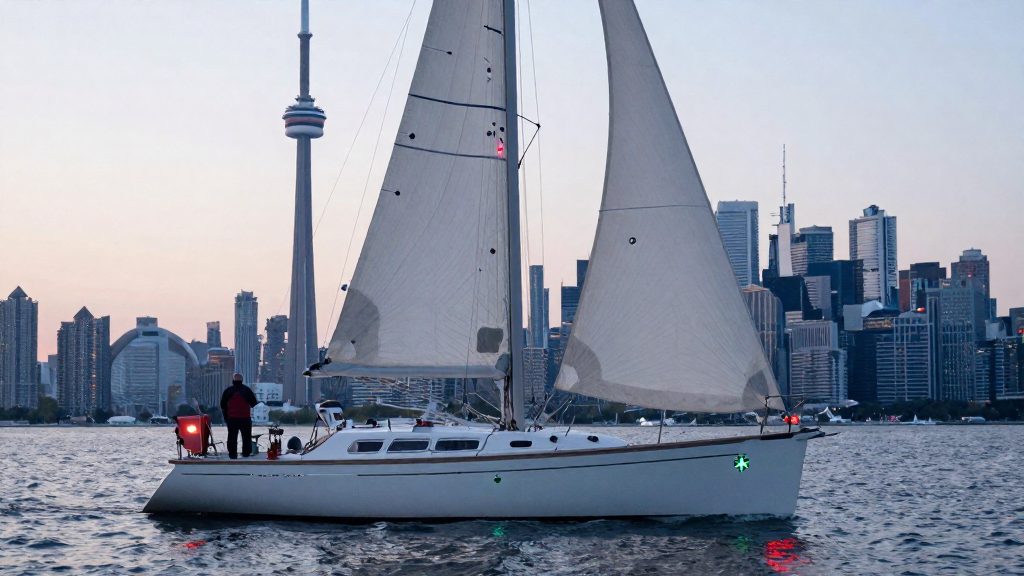
The phrase right of way is common on the water, but the Collision Regulations do not build the rules around it. They speak instead of a give-way vessel, which must keep out of the way, and a stand-on vessel, which must keep its course and speed (Rule 17). Thinking in these two roles tells you what to do at each moment. If you are the give-way vessel, your job is to act early. If you are the stand-on vessel, your job is to hold your course and speed while you watch the other boat.
The give-way vessel must, so far as possible, take early and substantial action to keep well clear (Rule 16). A small, late change of course is not enough, because the other skipper may read it as no change at all. The stand-on vessel is not left powerless either. The Collision Regulations allow it to take action to avoid a collision once it becomes apparent that the give-way vessel is not doing so.
How is priority shared between sailboats and power boats?
The general rule for this pairing is in Rule 18(a): a power-driven vessel underway keeps out of the way of a sailing vessel. This is the rule most recreational boaters meet first. It applies whenever a motorboat and a sailboat meet while both are underway.
The Collision Regulations define a power-driven vessel as one propelled by machinery. A sailboat that is also running its engine is therefore a power-driven vessel, even with its sails up. Under engine, it loses the sailing priority and must keep out of the way of other sailing vessels, as well as follow the power-against-power rules when it meets other powered boats. Under sail alone, it keeps the sailing priority over a power boat.
Sailboats are not exempt from give-way duties. Under Rule 18(b), a sailing vessel underway must keep out of the way of a vessel not under command, a vessel restricted in its ability to manoeuvre, and a vessel engaged in fishing. When you are under sail near a fishing boat, a vessel working in a restricted area or a vessel that cannot steer normally, plan a wide passing distance and do not assume the other boat can move out of your path.
How do two sailboats decide who keeps clear?
Rule 12 covers sailing vessels meeting each other. When the two vessels have the wind on different sides, the vessel with the wind on its port side keeps out of the way of the other. In everyday terms, a boat on port tack gives way to a boat on starboard tack. When both vessels have the wind on the same side, the windward vessel keeps out of the way of the leeward vessel.
These rules depend on identifying the wind side correctly. Do not guess from a sail that looks full or from a boom that seems to point one way. Check the actual wind direction against the vessel’s heading, and at night rely on the lights the other vessel is showing rather than on what you think you can see. If you cannot be sure which side the wind is on, act as though the other boat has priority and give it plenty of room.
How do two power boats handle head-on, crossing and overtaking situations?
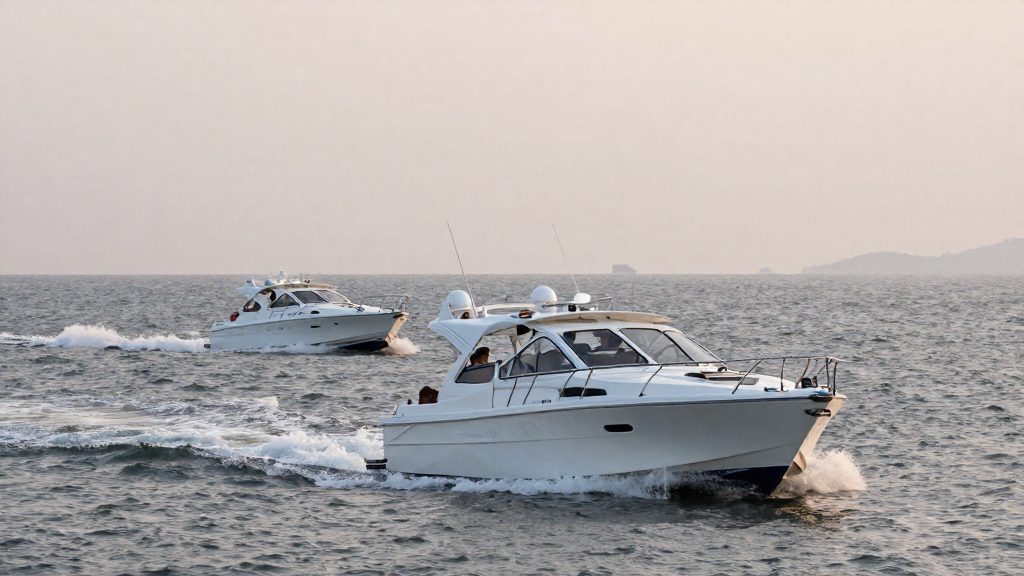
For two power-driven vessels meeting head-on or nearly head-on, Rule 14 requires each to alter course to starboard, so that each passes the other on its port side. Neither vessel holds priority in this case, and both must act.
In a crossing, Rule 15 is decisive. The vessel that has the other on its own starboard side keeps out of the way. Put plainly, the vessel that sees the other boat on its right gives way. The other vessel, which has the first boat on its port side, is the stand-on vessel and keeps its course and speed. If circumstances allow, the give-way vessel should avoid crossing ahead of the other.
Overtaking is different because it does not depend on the type of boat. Under Rule 13, any vessel overtaking another keeps out of the way of the vessel being overtaken. A vessel that is unsure whether it is overtaking must assume that it is. Keep this in mind on a crowded anchorage or a long reach, where a faster boat may be closing on a slower sailboat from behind.
When does the river crossing rule change the picture?
Canada modifies Rule 15 for rivers. Under the Canadian modification in Rule 15(b), a vessel crossing a river must keep out of the way of power-driven vessels going up or down the river. The St. Lawrence River seaward of Île Rouge is excepted. A sailboat or a small power boat crossing a river therefore cannot assume that the usual crossing rule protects it.
On a river, a power-driven vessel moving upstream or downstream may be restricted by the channel and the current, and its manoeuvring room may be limited. Give it a clear path, cross at a right angle where practicable, and do not stop in the middle of the channel. Where the river widens or the traffic is heavy, reduce speed and keep a proper lookout.
How do narrow channels change priorities?
In a narrow channel or fairway, Rule 9(a) requires a vessel to keep as near as is safe and practicable to the outer limit of the channel on its starboard side. This applies to every vessel in the channel, and it is the first thing to do when you enter one.
Rule 9(b) adds a specific duty. A vessel of less than 20 metres in length, or a sailing vessel, must not impede the passage of a vessel that can safely navigate only within the narrow channel. This matters most when a sailboat is tacking across a channel that a large vessel needs. A sailboat that might block a ship must keep clear, even if its tack would otherwise give it priority, so plan your tacks well before the channel becomes crowded and keep a close watch on large vessels ahead and behind.
What should you do when the other boat does not give way?
If you are the stand-on vessel and the other boat is not doing what the rules require, do not assume it will change. Keep your course and speed as long as the situation allows, but watch the other vessel closely. As soon as it becomes clear that the give-way vessel is not taking action, act to avoid a collision. A large, early change is safer than a small, late one, and it should be made in a direction that does not put you in the path of another boat.
If you are the give-way vessel and the other skipper does not seem to see you, make your intentions unmistakable. Change course early and clearly, and reduce speed if needed. Do not rely on the other boat behaving as you expect. Some skippers know the rules well, while others do not, and the Collision Regulations do not oblige a vessel to predict another’s mistakes.
In restricted visibility, such as fog, proceed at a safe speed adapted to the prevailing circumstances and conditions (Rule 19(b)). Keep a proper lookout by sight and hearing, and do not rely on the rules alone to avoid a collision. If you cannot judge the risk, slow down or stop, and avoid any manoeuvre that brings you closer to another vessel.
Frequently asked questions
Are these rules the same on every lake in Canada?
The Collision Regulations apply on Canadian navigable waters. The official sources consulted do not list local or provincial rules, so check with the local authority for any additional bylaws that may apply to your waterway.
Do the priority rules apply to a boat at anchor?
The priority rules in Rule 18 apply between vessels underway. A boat at anchor or made fast to shore is not underway, but it is still an obstacle, so keep well clear of it and avoid passing close to its position.
Is the give-way duty ever absolute?
No. The give-way duties in the Collision Regulations must be applied with common sense and with the aim of avoiding a collision. A vessel with priority should still act if a collision looks likely, and a give-way vessel should not wait for the other boat to move first.