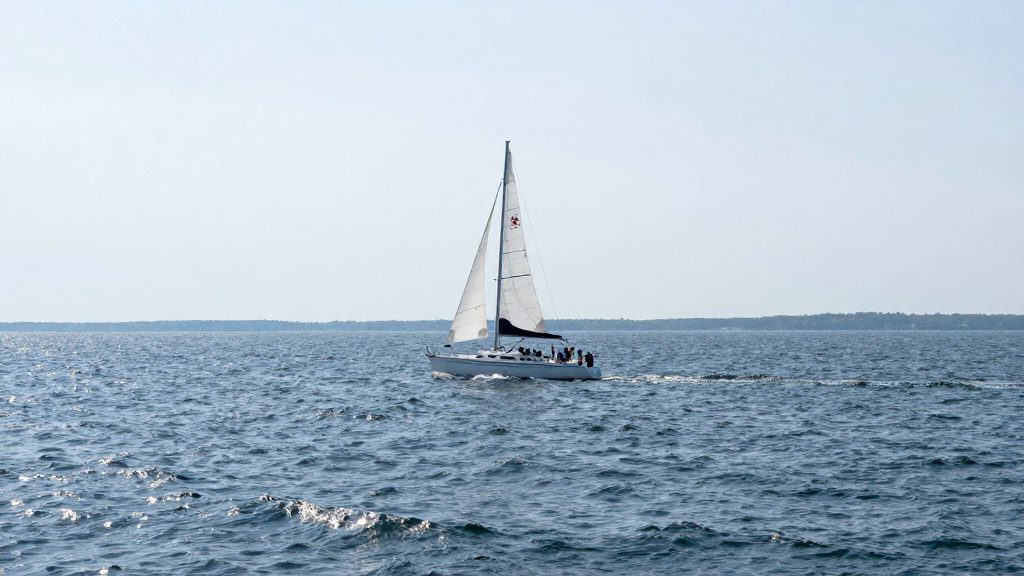
When two power-driven boats are crossing and there is a risk of collision, the boat that has the other on its own starboard (right) side is the give-way vessel. It must keep out of the way, act early and substantially, and avoid crossing ahead of the other boat. The boat with the other on its port (left) side is the stand-on vessel. It keeps its course and speed, and may act on its own only when the give-way boat is clearly not taking appropriate action or when the give-way boat alone cannot avoid a collision. These principles come from the Collision Regulations (C.R.C., c. 1416), which are consolidated on the Justice Laws website of the Government of Canada.
What counts as a crossing situation?
Rule 15 of the Collision Regulations covers two power-driven vessels crossing “so as to involve risk of collision”. In practice, a crossing exists when two boats are on converging courses. A boat heading straight at you, or one coming up on you from behind, falls under other rules. The risk matters more than the angle: if the other boat’s compass bearing stays nearly the same while the distance closes, the two boats are on a collision course, whatever the angle looks like at first glance.
Transport Canada’s Safe Boating Guide describes its crossing guidance as applying in good visibility and refers readers to the Collision Regulations for other conditions. When visibility is reduced, Rule 19 requires every vessel to proceed at a safe speed adapted to the prevailing circumstances and conditions. A vessel that detects another vessel only by radar must determine whether a close-quarters situation is developing and whether a risk of collision exists.
Who gives way when two power boats cross?
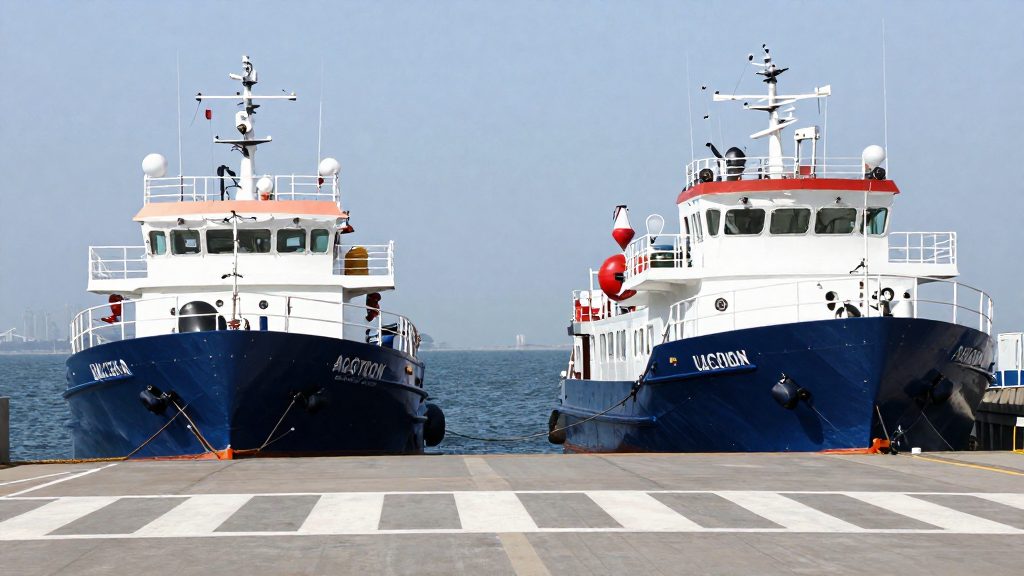
The give-way vessel is the one that has the other vessel on its starboard side. Rule 15 states that the vessel which has the other on her own starboard side shall keep out of the way. Section 1 of the Regulations defines a give-way vessel as a vessel that is required to keep out of the way of another vessel.
Read the situation from your own position. If the other boat appears on your port side, you are the stand-on vessel. If it appears on your starboard side, you are the give-way vessel. Transport Canada gives the same two cases in its guide and adds that, when you are the stand-on vessel, the other boat must keep out of your way.
Two points prevent confusion. First, the side is determined by where the other boat sits relative to your bow, not by the direction in which it is heading. Second, the rule assigns the duty to act; it does not cancel the other boat’s duty to avoid a collision once it becomes apparent that you are not responding.
How does the give-way boat manoeuvre?
Rule 16 requires the give-way vessel to take early and substantial action to keep well clear, so far as possible. Early means before the situation becomes urgent. Substantial means a change the other crew can see and interpret without guessing. A slight adjustment of the helm is rarely enough.
Rule 15 adds that the give-way vessel should avoid crossing ahead of the other vessel, if the circumstances of the case admit. Passing astern of the stand-on boat gives it a clear and predictable picture. Depending on your speed and the distance, you can alter course to pass astern, slow down, stop, or combine these actions. Slowing down is often the most readable response in a busy area, because it gives the other crew more time to see what you are doing. Avoid turning toward the other boat’s path in a way that cuts across its bow.
Keep the action in place until the other boat is clear. Do not swing back early because the situation looks less urgent, since the other boat may still be closing. Check the bearing after each change rather than assuming the first change was enough.
Why must the stand-on boat keep its course and speed?
Rule 17 provides that, where one of two vessels is to keep out of the way, the other shall keep her course and speed. The reason is predictability. The give-way boat plans its move around the stand-on boat’s steady path, and a sudden change by the stand-on boat can create a new danger just as the give-way boat is reacting.
The stand-on vessel is not a passive observer. Rule 17 sets out the exceptions. It may take action to avoid collision by its manoeuvre alone as soon as it becomes apparent to it that the give-way vessel is not taking appropriate action. When a collision cannot be avoided by the action of the give-way vessel alone, it must take whatever action will best aid to avoid collision. If the circumstances admit, it must not alter course to port for a vessel on its own port side. Rule 17 also states that it does not relieve the give-way vessel of its obligation to keep out of the way.
Rule 2 adds a general principle: nothing in the Rules exonerates any vessel, or its owner, master or crew, from the consequences of neglect to comply with them, and due regard must be given to all dangers of navigation and collision. Knowing the rule is necessary, but it does not replace watching the other boat.
Do the Collision Regulations apply to small boats?
Yes. Transport Canada’s guide states that some requirements, such as those in the Collision Regulations, apply to all vessels, and that the Regulations also apply to small vessels. The Regulations apply to all vessels on Canadian navigable waters, so an open motorboat on a lake follows the same crossing principles as a larger cruiser. The official sources consulted for this article do not describe a size-based exemption from the crossing rule itself.
When does the crossing rule not apply?
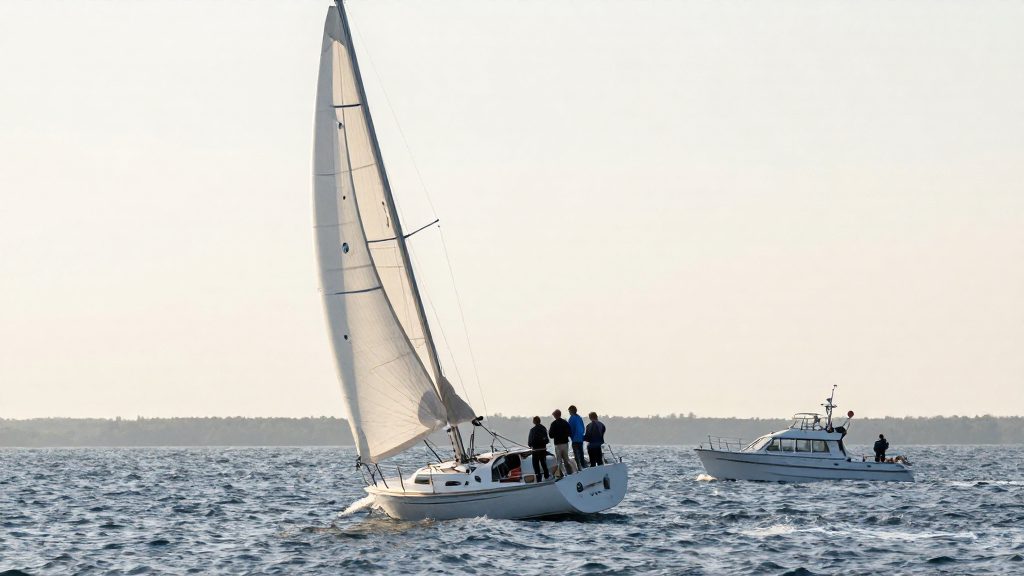
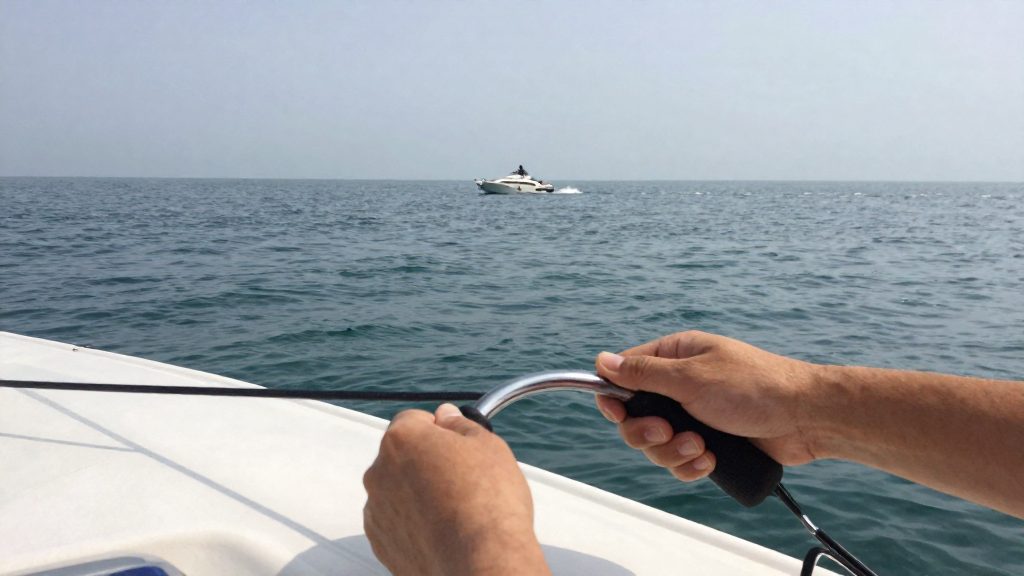
Several situations take precedence over the starboard rule. Rule 18 provides that, except where Rules 9, 10 and 13 otherwise require, a power-driven vessel underway must keep out of the way of a vessel not under command, a vessel restricted in her ability to manoeuvre, a vessel engaged in fishing, and a sailing vessel. A sailing vessel underway must keep out of the way of the first three of these. In practice, a powerboat generally gives way to a sailboat whichever side the sailboat appears on.
Overtaking has its own rule. Under Rule 13, any vessel overtaking another shall keep out of the way of the vessel being overtaken. A vessel is treated as overtaking when it comes up with another vessel from a direction more than 22.5 degrees abaft her beam, which is the sector behind the other boat’s beam, toward its stern.
Canadian waters add exceptions as well. Rule 15 has a Canadian modification that overrides the starboard rule: in Canadian waters, a vessel crossing a river must keep out of the way of a power-driven vessel ascending or descending the river, except on the St. Lawrence River seaward of Île Rouge. In narrow channels with a current, the Canadian modification to Rule 9 makes the vessel with the current the stand-on vessel, and it proposes the passing place. Under the Canadian modification to Rule 10, a power-driven vessel over 20 metres must use an applicable traffic separation scheme and routing system, subject to the exemptions the Regulations set out.
The official sources consulted for this article do not cover crossings between two sailing vessels. Consult Rule 12 of the Collision Regulations directly for that situation.
How should you use signals and speed?
When you are in doubt about another vessel’s intentions, the Regulations give you a signal. A vessel in doubt must immediately indicate that doubt by giving at least five short and rapid blasts on the whistle (Rule 34). A short blast lasts about one second and a prolonged blast lasts four to six seconds (Rule 32). The signal does not change who must give way under Rule 15; it only alerts the other boat that your intentions are unclear.
Speed is your other tool. In restricted visibility, Rule 19 requires a safe speed, and a vessel that can be kept on course at a reduced speed should reduce speed to the minimum at which it remains controllable. Slowing early when the bearing is steady and the other boat is closing gives both crews more time to decide.
Do not resume your original course until the other boat is clearly past and its bearing is opening. The official sources consulted do not give a distance for this, so judge it by sight and, if you have radar, by the plotted track of the other vessel.
What are the common mistakes in crossing situations?
The mistakes below are the ones most often seen in practice:
- Misreading the side on which the other boat appears at dusk, in glare, or when your own lights and their reflections blur the picture. Check the bearing again before deciding.
- Accepting a steady compass bearing as harmless because the other boat looks far away. A distant boat on a collision course can close the gap quickly.
- Waiting until the situation is urgent before acting, which leaves too little room for a manoeuvre the other crew can read.
- Reading the other boat’s movements as a clear statement of its intentions. A stand-on boat that suddenly changes course can create the very danger the rule is meant to prevent.
Frequently asked questions
Does the crossing guidance change at night?
The crossing guidance in the Safe Boating Guide is written for good visibility. The lights a boat must show and how they are interpreted are set out in the Collision Regulations, which the sources consulted for this article do not reproduce. Read those provisions before a night passage.
Are the overtaking rules different on the Great Lakes?
Canadian modifications apply to Great Lakes Basin waters in several places, including overtaking, where a different sightline test applies. The exact wording is in the Regulations, so read that provision before boating on the Great Lakes.
Does calling the other boat on the radio change who gives way?
No. The crossing rule assigns the duty by the side on which the other boat appears. A radio exchange can help clarify intentions, but it does not reverse those roles, and the official sources consulted do not present it as a substitute for the Rules.