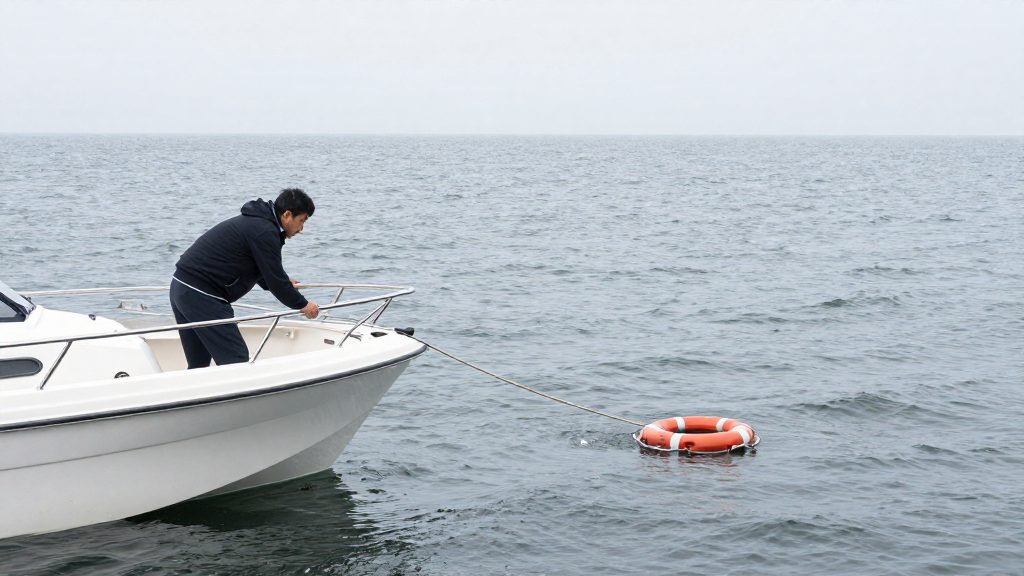
If someone falls overboard, shout “Overboard” so everyone on board knows, throw the nearest buoyant object toward the person straight away, and stop the boat. Then assign one crew member to keep the person in sight at all times, bring the boat back carefully, and recover the person from the side of the boat without entering the water. These steps follow Canadian guidance and apply to every type of boat, although the manoeuvres to return differ under power and under sail. Report the emergency to the Canadian Coast Guard as soon as you can.
Why does the first minute matter so much?
A person who falls from a moving boat is left behind very quickly, and a boat that keeps moving can carry the person toward the propellers. According to Canadian Boating (2022), a boat travelling at 10 knots covers about 5 metres every second, so even a few seconds of delay can leave several metres between the boat and the person. Waves can hide a swimmer for long periods, and cold water can cause gasping and loss of breath control within minutes, before the person has any chance to swim to safety. Speed of response is the factor you control most directly.
How do you act in the first seconds?
The Canadian sequence is simple enough to memorize and to practise with your crew. According to Canadian Boating (2022), the steps are the following.
- Shout: call “Overboard” loudly so that the whole crew knows someone is in the water and can take a role.
- Throw: toss the nearest floating object toward the person at once. If you have a life ring or a man-overboard pole, throw it next, so the person has something to hold.
- Stop: bring the boat to a halt right away. Transport Canada (2007) also says to stop the engines and turn the bow in the direction of the person.
- Mark: note the position. If your boat has a GPS or chartplotter, save a waypoint, and check the manufacturer’s documentation for how your device stores it.
These actions are taken together and quickly, because each second of delay increases the distance you must cover to return.
Why does one crew member need to keep watch?
One person should be assigned as lookout, with the sole job of keeping the person in the water in sight. According to Canadian Boating (2022), this crew member keeps pointing at the victim and guides the helmsman, and Transport Canada (2007) gives the same instruction. Waves can hide the person between swells, which makes this role difficult, so it should not be combined with steering or with throwing equipment. Once the lookout loses sight of the person, the helmsman has no reliable reference, which is why the lookout must stay focused on that single task.
How do you return to the person and recover them?
The method depends on whether the boat is under power or under sail, and the choice should be made quickly, based on wind, sea state and boat handling ability.
Under power, Canadian Boating (2022) describes the Williamson turn. Turn the rudder toward the side the person fell from. Once clear of the person, go full ahead with the rudder hard over until the boat has turned about 60°, then reverse the rudder to head back. Transport Canada (2007) recommends this slower but easier method when there is danger of losing sight of the person. Approach at low speed, and when you are several metres away, put the engine in neutral and throw a line or lower a recovery sling.
Under sail, the quick stop is to turn into the wind and circle slowly while dragging a ring buoy or a line toward the person. In strong wind, the figure-eight method avoids a jibe: reach away for a few seconds, tack, and reach back toward the person, approaching at minimum steerage speed or heaving to. Keep the sails trimmed and the jib sheet in place when tacking or jibing, so that the boat does not lose its manoeuvring control.
When the person is close abeam, check that the propellers have stopped completely, because moving propellers can cause serious injury (Canadian Boating, 2022). Never put the boat in a position where the person could drift under the hull.
When is it safe to bring the person aboard?
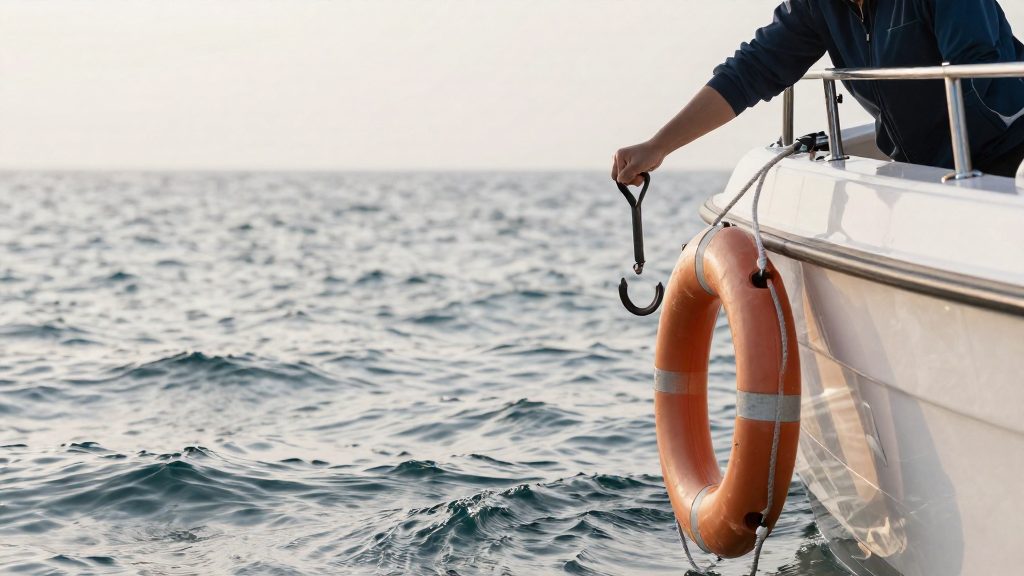
In heavy seas, bring the person over the side rather than over the stern, and lift the person horizontally rather than upright, since a horizontal body is less likely to collapse. If the freeboard is under about two feet (60 cm), two crew members can each grip one arm and one shoulder and hoist the person aboard while facing them (Canadian Boating, 2022). Rescuers should take care when pulling the person in, because Transport Canada (2007) warns that many would-be rescuers have been dragged into the water by the person in distress. Keep a secure handhold and have a second crew member hold you.
If the person is injured, weak or unconscious, do not attempt a lift from the water. Launch a dinghy or liferaft on a long line and recover the person from there. Never enter the water to reach them.
Once the person is aboard, lay them down gently and remove wet clothing. Wrap them in a blanket or sleeping bag, and give warm drinks only once they are fully conscious, avoiding alcohol and caffeine. If you are trained and the person is not breathing normally, begin rescue breathing or CPR and continue until breathing and a heartbeat return (Canadian Boating, 2022).
How do you call for help and report the position?
Report any marine emergency to the Canadian Coast Guard, which operates 24/7. The Coast Guard lists the telephone numbers 1-800-463-4393 or 418-648-3599, VHF radio channel 16 (156.8 MHz), Digital Selective Calling channel 70, and MF radio 2182 kHz (Canadian Coast Guard, 2024). Assign a crew member to make the call while the rest of the crew carries out the recovery. Give the position you marked, the number of people on board, and the condition of the person in the water, so that responders can prepare.
How can crews prepare before a fall happens?
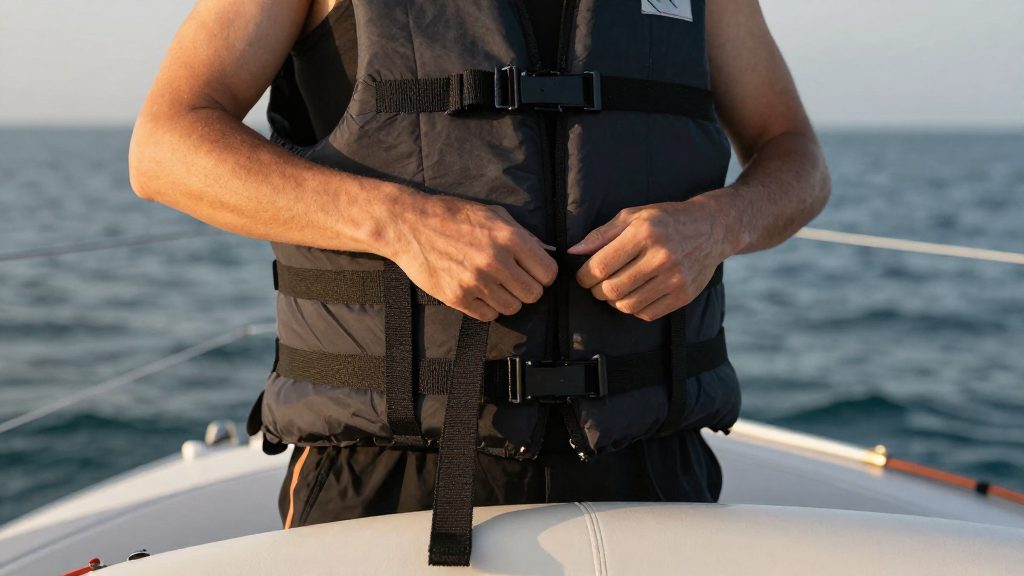
Prevention matters as much as the response. The Canadian Coast Guard recommends wearing a lifejacket at all times (Canadian Coast Guard, 2024). Before leaving the dock, brief every crew member on the sequence of shout, throw, stop and mark, and agree who will act as lookout and who will handle the radio. Keep throwable flotation within reach of the helm, and check that any recovery line is ready to use and not tangled. Practising the sequence in calm conditions, at low speed and with a flotation object, lets the crew learn the roles before they need them in a real emergency.
Frequently asked questions
Can a GPS or man-overboard function replace a lookout?
No. A saved position helps you return to the person, but it cannot keep the person in sight or steer the boat. Check the manufacturer’s documentation to see how your device stores and returns to a position.
What should I do if I am alone on the boat?
The official sources consulted do not give a single-handed procedure. Throwing flotation and marking the position still come first, and you should read your boat’s documentation before relying on any autopilot or automatic steering.
Should I report a person who was recovered quickly?
The official sources consulted do not specify this. The Canadian Coast Guard accepts reports of any marine emergency at any time, so calling is a reasonable choice when you are unsure.