When should you abandon ship?
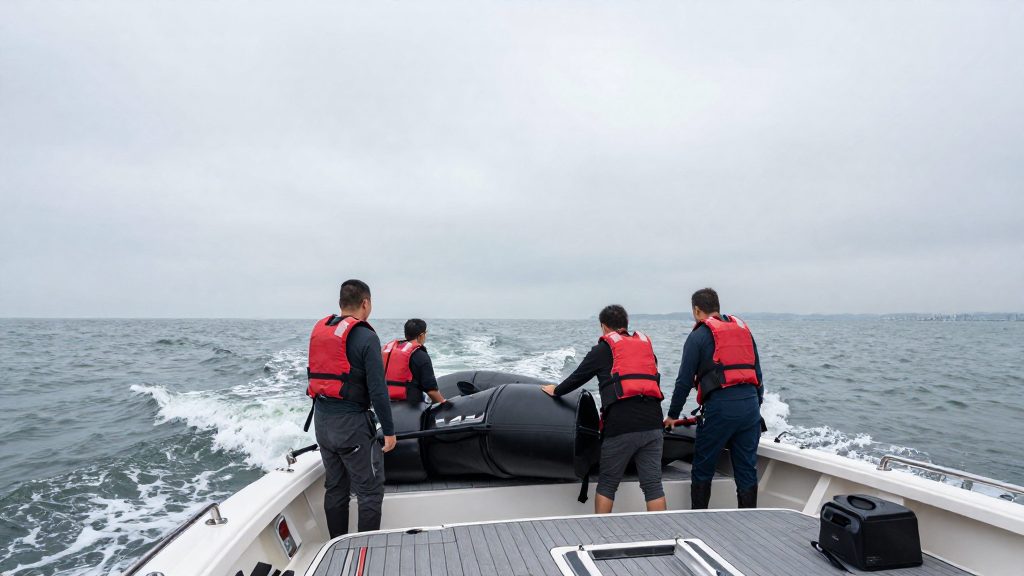
An abandon ship procedure is a last resort. Stay with the boat unless it is sinking beneath you, or a fire, uncontrolled flooding or structural damage makes staying aboard more dangerous than leaving. This is general seamanship practice rather than a single statutory test, so the decision rests on judgment made under pressure. Make it early, while the crew is still steady and before the deck is awash.
Before you decide, answer three questions quickly. Can the leak or fire be controlled with the pumps, extinguishers and damage-control gear aboard? Will the hull keep enough freeboard for the crew to stay on board and be seen? Is shore, or another vessel, close enough that a survival craft would not be needed? If the answers are not reassuring, prepare to leave. Do not go back below for possessions once water is coming over the sills or smoke makes the cabin unsafe.
What should the crew do before leaving the boat?
Send a distress call first, if the situation allows it. Use the marine VHF radio on channel 16 (156.8 MHz), the international distress frequency that the U.S. Coast Guard monitors. Open with “Mayday” repeated three times, then the vessel name, your position, the nature of the distress, the help you need and the number of people aboard. Keep the handset on hand and stay on the channel until you are told otherwise.
If your radio is digital selective calling (DSC) equipped and has an MMSI programmed, the distress button sends an automated alert with your identity. Hold it for the time specified in your radio’s manual. Confirm that the radio is connected to a GPS source, because an alert without position data is much less useful to rescuers.
Next, activate your emergency beacon. A 406 MHz emergency position-indicating radio beacon (EPIRB) or personal locator beacon (PLB) sends a coded signal through satellites to search and rescue services. Check that it is registered to your boat and that the registration details are current. Activate it only when you are truly in distress, because a false alert wastes responders’ time and can carry consequences. Take a PLB with you. An EPIRB should be in its bracket so that it floats free if the boat sinks.
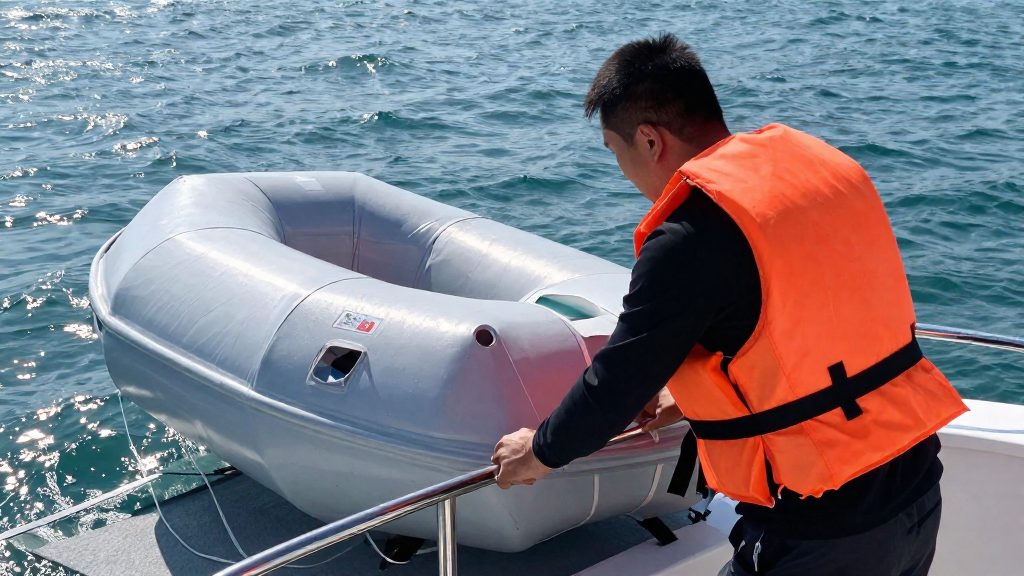
Finally, gather what you can carry without delay. Put on your PFDs and warm, layered clothing. Place ship’s papers, medications, a handheld VHF radio, a flashlight, a knife, a first aid kit, drinking water and a phone in a sealed waterproof bag. Make sure everyone knows where the survival craft and the emergency gear are stowed.
Which safety gear is required by federal rules in the US?
Federal carriage requirements for recreational boats are set out in Title 33 of the Code of Federal Regulations, Part 175. They are minimums. State and local rules can be stricter, and your boating agency is the authority for waters under its jurisdiction. Non-U.S. rules differ and do not apply to boats on U.S. waters.
Under 33 CFR 175.15(a), each recreational boat must carry at least one wearable personal flotation device (PFD) for each person aboard. Under 33 CFR 175.15(b), a boat 16 feet or more in length must also carry one throwable PFD, in addition to the wearable devices. A PFD that is stowed in a locker does not help anyone in the first minutes after entering the water, so the rule for crews is simple: wear the device before the emergency, and check its condition and fit.
Under 33 CFR 175.110, a boat 16 feet or more in length may not be used on coastal waters, including the Great Lakes and waters connected to them, unless it carries the required visual distress signals listed in 33 CFR 175.130 or 175.135. Those sections list the device combinations that satisfy day and night requirements. In practice, an orange distress flag is a day signal, and an electric distress light is a night signal. Pyrotechnic signals carry an expiration date set by the manufacturer under Coast Guard approval, and an expired device should not be counted on. Check the date printed on each one.
Boats under 16 feet must carry night-use signals when they are operated between sunset and sunrise, under the same sections. Keep your signals in an accessible place, not buried under gear, so that they can be used at once.
How do you launch and board a liferaft safely?
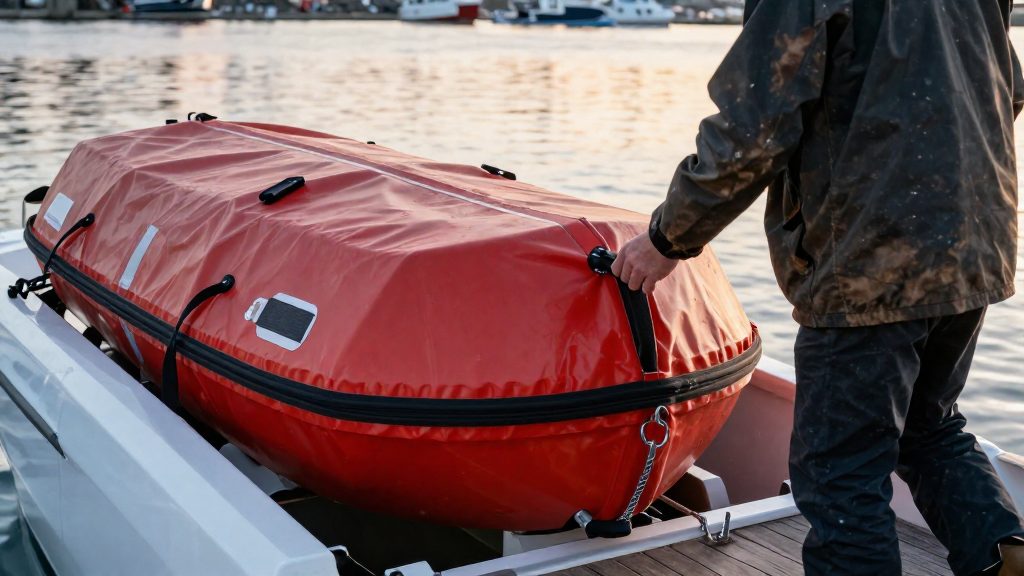
A liferaft is only useful if the crew knows how to deploy it under stress. Read the manufacturer’s manual for your raft and check its service date, container location and launch method, whether manual or hydrostatic release. Practice the drill with the whole crew in calm conditions, if the raft’s design allows it.
When the decision is made, follow these steps in order, adjusting for the specific equipment:
- Put on PFDs and warm clothing, and assemble the crew at the launch point, away from fire, fuel vapour and sharp fittings.
- Secure the painter, which is the line attached to the raft, to a strong deck cleat or structural point before throwing the container overboard. A container thrown over unsecured can drift away before it inflates or can be reached by the crew.
- Throw the container downwind and clear of the hull, then pull the painter as the manual directs to start inflation.
- Board by stepping down or across into the raft, not by jumping. Jumping can puncture the floor or injure people. Keep knives, tools and other sharp objects away from the fabric.
- As soon as everyone is clear of the vessel, deploy the sea anchor, also called the drogue. It reduces drift in wind and waves and helps prevent the raft from capsizing in breaking seas.
- Keep the painter attached while the boat is still afloat. A raft tied to a vessel is a larger target for search and rescue. Cut the line only when the sinking boat threatens to pull the raft under, using the safety knife provided with the raft. If the raft sits in a cradle with a hydrostatic release, the release normally frees it as the boat goes down, but the line can tangle or fail, so the crew must be ready to cut it.
How do you survive once you are in the water or the raft?
Cold water is the most immediate threat in many U.S. waters. The National Weather Service states that cold shock can be just as severe and dangerous in water at 50–60°F (10–15°C), and that gasping can be triggered by water as warm as 77°F (25°C). Gasping and rapid breathing occur during the first 2–3 minutes or more. Muscle control can be lost within seconds of entering cold water, which makes self-rescue or staying afloat without help virtually impossible.
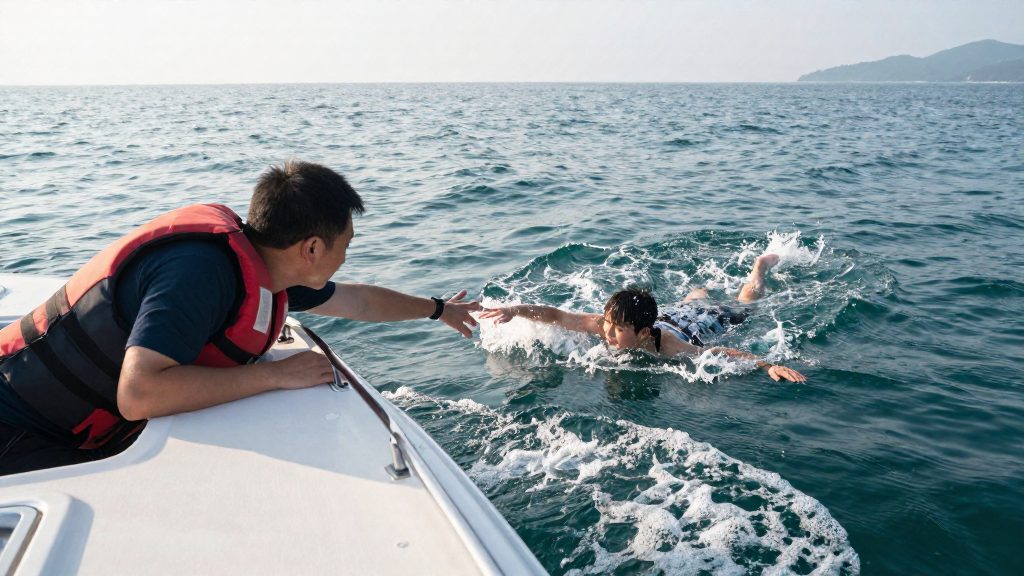
For that reason, keep your PFD on and your face out of the water. Control your breathing before attempting any movement. Do not swim unless the raft, the vessel or the shore is within reach and you have a clear plan to get there. Once you are aboard the raft, get out of the water completely, because body heat loss continues in wet clothing.
To limit heat loss in the raft, stay dry, insulate yourself from the floor where possible and keep close together. The National Weather Service notes that core body temperature can continue to fall after a person leaves the water, so warming must be gradual and gentle, and rough handling of a cold casualty should be avoided. Do not drink seawater. Water and food rationing differ between manufacturers’ manuals and survival guidance, so follow the instructions supplied with your raft and the emergency kit.
Keep the raft visible and use your signals only when a vessel or aircraft is in range, so that the supply lasts. Stay with the raft unless rescue is imminent and within your reach. Let rescuers find you, and keep the crew accounted for at all times.
How do you keep the plan ready between trips?
An abandon ship procedure works only if the equipment still works. Keep a written checklist on board and review it before each season. Confirm that PFDs are in good condition and fit each person, that throwable devices are reachable, and that visual distress signals are unexpired. Have the liferaft serviced at the interval stated by its manufacturer, and check the beacon battery and registration. Make sure the crew knows the roles, the location of the emergency bag and the sequence for the radio, beacon and liferaft.
Review the plan after any change to the boat, its equipment or the waters you sail in. A plan that was sound for a day sail on protected water may not hold for an offshore passage.
Frequently asked questions
Do I need a liferaft on a small recreational boat?
The federal carriage rules in 33 CFR Part 175 set minimum PFD and signaling requirements and do not require a liferaft for every recreational boat. Decide based on your boat, the waters you sail and your plan. Check state requirements too.
Should I send a Mayday if rescue seems close?
Yes, if you are in grave and imminent danger. Radio calls are the quickest way to tell responders your position and condition, even when another boat appears to be nearby.
Is an inflatable tender a substitute for a liferaft?
No. A tender is not designed as a survival craft and lacks a canopy, sea anchor and survival equipment. Use it only as a boat, and follow the manufacturer’s guidance on its limits.
What should I do if I activate my beacon by mistake?
Contact the responding authority by radio as soon as possible and say that the alert was accidental, so that the search is stopped and resources are not wasted.