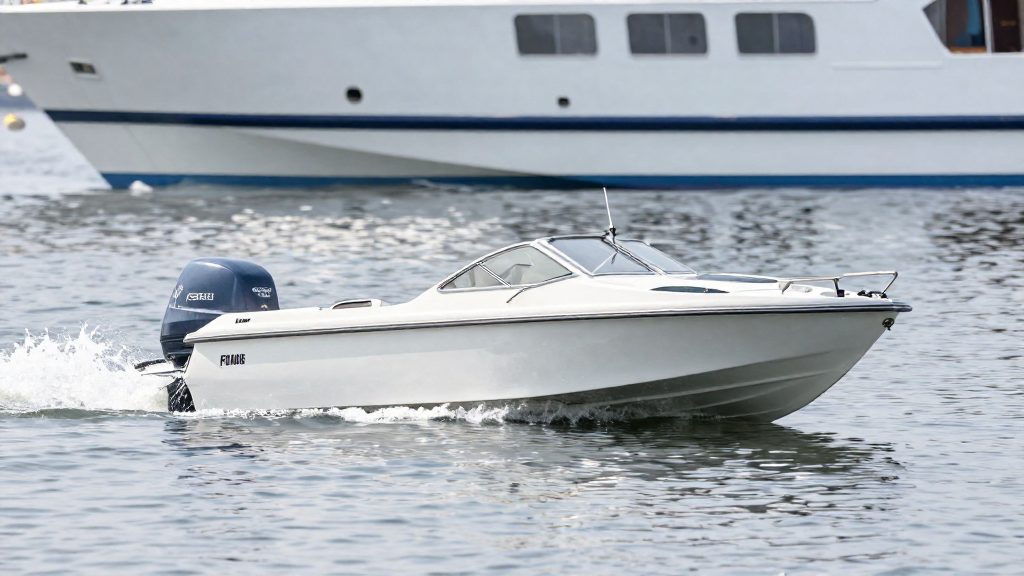
Which rules govern the water you are on?
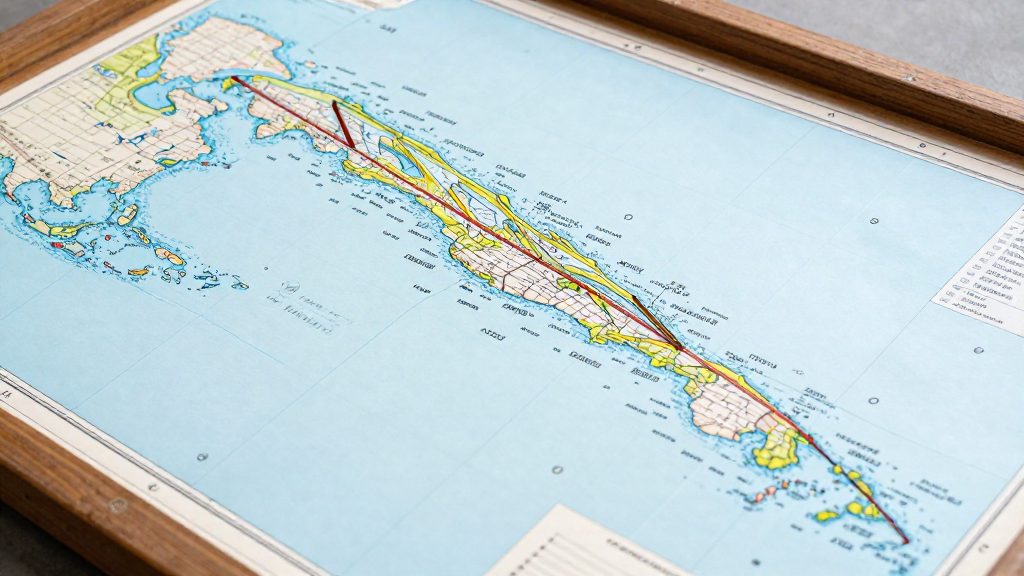
Before you can dodge traffic, you need to know which set of rules applies. In the United States there are two. The Inland Navigation Rules, codified in 33 CFR Part 83, apply to waters inside the demarcation lines set under 33 CFR Part 80. The International Regulations for Preventing Collisions at Sea, 1972 (COLREGS), apply to waters outside those lines. The regulation states it directly: waters inside the lines are Inland Rules waters, and waters outside the lines are COLREGS waters.
Most lakes, rivers, bays and harbors sit on the inland side, so the Inland Rules are the ones you will use most. The core right-of-way provisions are closely similar in both sets, which is why the advice below applies broadly. If you are unsure which side of a line you are on, check the charted boundary and local guidance before you rely on either set of rules.
What does dodging traffic actually require?
Right-of-way rules decide who must give way, but they never excuse anyone from acting well. Every vessel must proceed at a safe speed so that it can take proper and effective action to avoid collision. The safe speed rule tells you to weigh visibility, traffic density, your vessel’s maneuverability with special reference to stopping distance, and background light such as shore lights. If your boat carries operational radar, you must also account for the capabilities and limits of that equipment (33 CFR 83.06).
When action is needed, it should be positive, made in ample time, and consistent with good seamanship (33 CFR 83.08). Avoid a succession of small alterations of course or speed, because they are hard for another operator to read. If you need to gain time to assess a situation, slacken speed or take all way off, including by stopping or reversing propulsion. A give-way vessel must take early and substantial action to keep well clear (33 CFR 83.16). Early and visible is the goal: a late, marginal turn often leaves you in the other boat’s path.
Crossing situations: who gives way?
When two power-driven vessels are crossing so as to involve risk of collision, the vessel that has the other on its starboard side must keep out of the way. If another boat is on your right, you are the give-way vessel. If it is on your left, you are the stand-on vessel. The give-way vessel should, if circumstances allow, avoid crossing ahead of the other (33 CFR 83.15(a)).
There is an important exception. On the Great Lakes, on Western Rivers, and on waters specified by the Secretary, a power-driven vessel crossing a river must keep out of the way of a power-driven vessel ascending or descending that river. This overrides the general starboard rule, so on those waters do not assume the usual answer applies (33 CFR 83.15(b)).
Head-on and overtaking: which way do you turn?
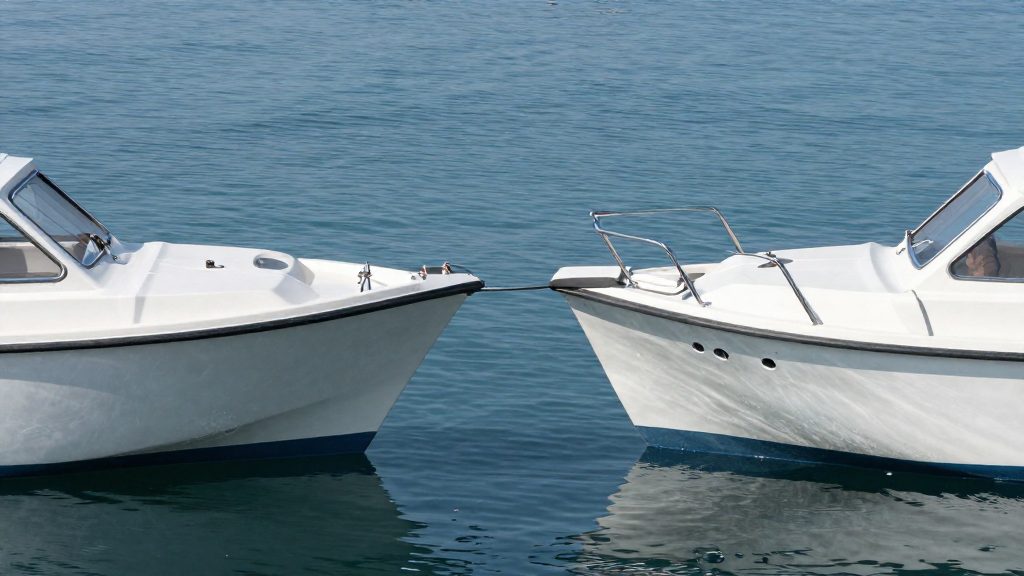
When you see another vessel ahead or nearly ahead, the rules treat it as a head-on situation. Each vessel must alter course to starboard so that each passes on the port side of the other (33 CFR 83.14(a)). Both boats turn to their right, which is the mutual and predictable answer. Turning to port in a head-on meeting puts you in the path of the other boat’s intended maneuver.
Overtaking is different. Any vessel overtaking another must keep out of the way of the vessel being overtaken. A vessel is overtaking when it comes up with another from a direction more than 22.5 degrees abaft its beam (33 CFR 83.13(a) and (b)). That makes the faster boat, approaching from behind, the give-way vessel. Its duty continues until it is finally past and clear, and a later change in bearing does not release it from that duty (33 CFR 83.13(d)). Do not cut back in front of the boat you have just passed.
When does the stand-on vessel have to act?
The stand-on vessel must keep its course and speed (33 CFR 83.17(a)). That does not mean doing nothing. The stand-on vessel may take action to avoid collision by its own maneuver alone as soon as it becomes apparent that the give-way vessel is not taking appropriate action under the rules. If the stand-on vessel finds itself so close that collision cannot be avoided by the give-way vessel’s action alone, it must take the action that will best aid in avoiding collision (33 CFR 83.17(b)).
In practice, keep your course and speed steady so the other operator can predict you. Watch the other boat’s behavior closely, and if it is clearly not turning or slowing as the rules require, be ready to act. Do not wait for a collision to become unavoidable before you move.
Safe habits for busy waterways
Traffic on the water rewards predictability and early decisions. Reduce speed in crowded areas, because a slower boat has more room to act and a shorter stopping distance. Scan ahead and around you regularly, and check whether an approaching boat’s bearing is changing. A steady bearing on a closing vessel means you are on a collision course, and you should act early.
Make every maneuver clear and deliberate, and avoid stacking small corrections that confuse the other operator. Where you must stop or reverse, do it early rather than at the last moment. Local ordinances and posted speed limits can add requirements beyond the federal navigation rules, so check them before you launch. Finally, do not rely on the other boat doing the right thing. Your job is to keep a safe distance whatever the other operator does.
Frequently asked questions
Do these rules apply to sailboats?
The crossing and head-on rules described here are written for power-driven vessels. Sailing vessels are governed by separate provisions within the same rules, so read the full Navigation Rules before sailing in busy traffic.
What if I am not sure whether I am overtaking or meeting head-on?
The rules tell you what to assume. If you are in doubt whether a head-on situation exists, assume it does, and if you are in doubt whether you are overtaking, assume that you are. Then act on that assumption early (33 CFR 83.14(c) and 83.13(c)).
Can I rely on the standard starboard rule on every waterway?
No. On the Great Lakes, on Western Rivers, and on waters specified by the Secretary, a power-driven vessel crossing a river must yield to a vessel ascending or descending that river, which overrides the usual starboard rule (33 CFR 83.15(b)).