When you must show navigation lights
On U.S. inland waters, the light rules apply from sunset to sunrise. During those hours you may not show any other light that could be mistaken for a required navigation light. The only exception is a light that cannot be confused with the required ones and that does not reduce their visibility or distinctive character or interfere with your lookout (33 CFR 83.20(b)).
The same lights are also required in restricted visibility, such as fog, haze, heavy rain, or smoke, even when it is daylight (33 CFR 83.20(c)). In practice, a boater who expects fog or dusk on the way back should either be at the dock before the light fades or have working lights ready.
Decorative lighting is the most common mistake. Rope lights, underwater lights, and bright deck fixtures can be mistaken for a required light, so they should be switched off whenever navigation lights are needed.
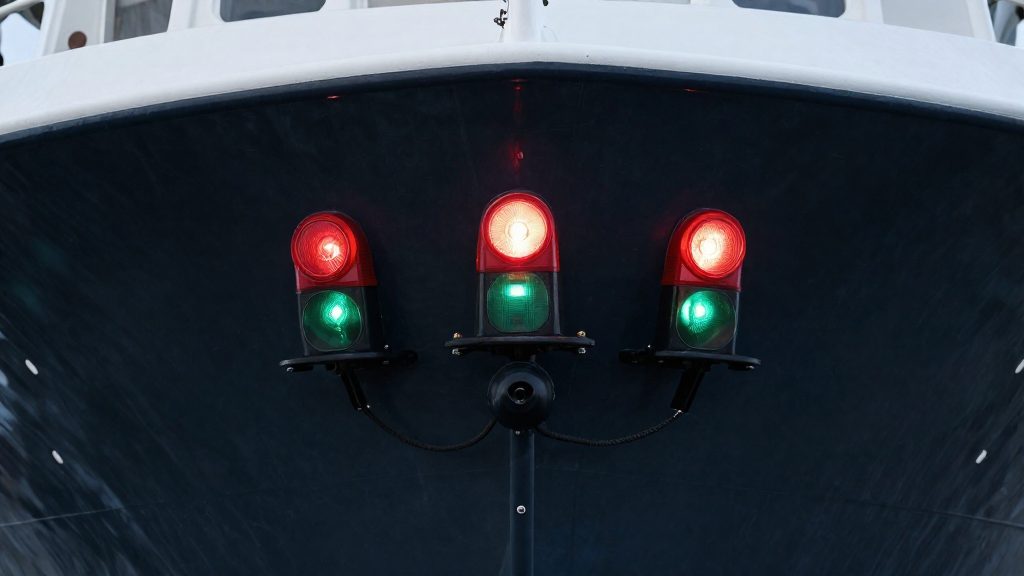
Which rules govern inland waters
The Inland Navigation Rules apply to all vessels upon the inland waters of the United States (33 CFR 83.01(a)). These rules set the lights, shapes, and sound signals you must use on lakes, rivers, canals, and most protected bays and sounds. Where inland waters end and international waters begin depends on boundary lines set in federal regulations. Your chart or your local marine authority can tell you which set of rules applies to a given stretch of water.
Federal rules are the baseline. A state or local agency may add requirements for its own waters, so check your state boating agency before a trip, especially on state-managed lakes and reservoirs.
Power-driven boats underway
A power-driven vessel underway must show a forward masthead light, a second masthead light aft of and higher than the first, sidelights, and a sternlight (33 CFR 83.23(a)). The second masthead light is optional on a vessel under 50 meters, but it may be shown.
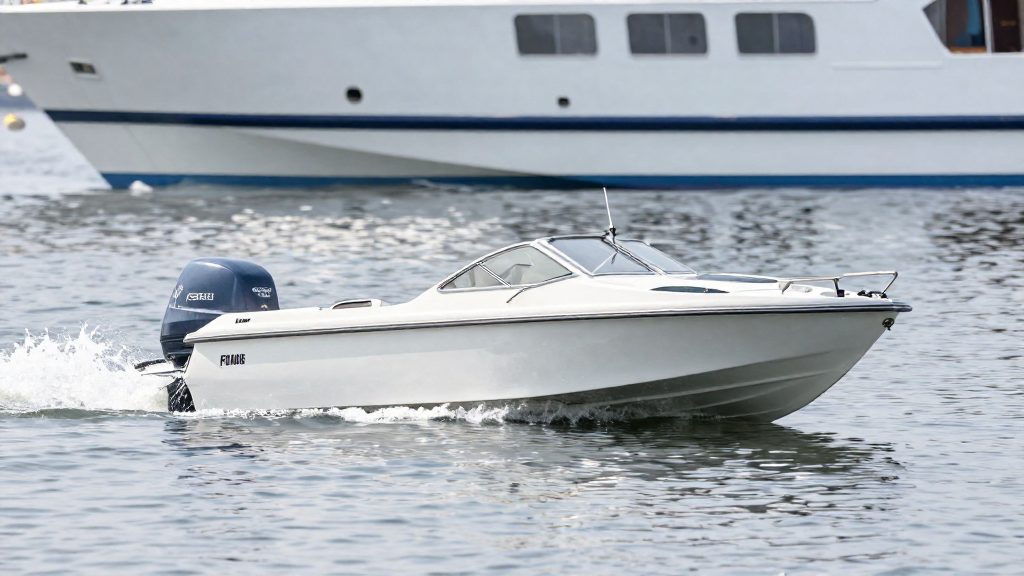
On a vessel under 12 meters (about 39 feet), the rule allows an all-round white light and sidelights in place of the masthead and sternlight set (33 CFR 83.23(d)). Most small outboards and runabouts use this arrangement. Make sure the all-round light is mounted where it can be seen from every direction, not behind a windshield, bimini, or cargo.
Light arcs and visibility ranges
The arcs of the horizon that each light must cover are set in 33 CFR 83.21:
- Masthead light: a white light over the fore-and-aft centerline, covering 225 degrees.
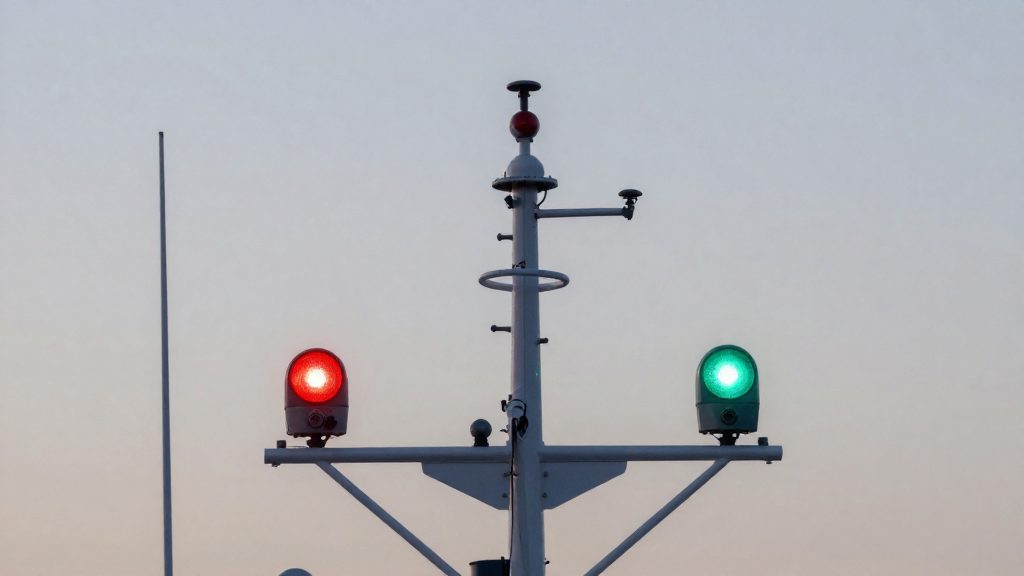
- Sidelights: a green light on the starboard side and a red light on the port side, each covering 112.5 degrees.
- Sternlight: a white light at the stern, covering 135 degrees.
- All-round light: a light covering 360 degrees.
The minimum distances at which each light must be visible are set in 33 CFR 83.22. For a vessel under 12 meters, the masthead light, sternlight, and all-round light must be visible from 2 miles, and the sidelights from 1 mile. For vessels from 12 meters to under 50 meters, the masthead light must be visible from 5 miles (3 miles if the vessel is under 20 meters), and the sidelights, sternlight, and all-round light from 2 miles. For vessels of 50 meters and over, the masthead light must be visible from 6 miles, and the sidelights, sternlight, and all-round light from 3 miles.
These are minimum ranges, and they apply in service, not just when the light is new. A cracked lens, a clouded cover, or a dim bulb can bring a light below its rated range. If a light looks weaker than it did last season, replace it or have it checked before you rely on it.
Mounting heights and spacing
Height and spacing requirements are set in 33 CFR 84.02, and they depend on the boat’s length. Measure with the boat at its normal loaded trim, because a heavy load or a raised bow can change the effective height.
- Under 12 meters: the masthead or all-round light must be at least 1 meter higher than the sidelights.
- 12 meters to under 20 meters: the masthead light must be at least 2.5 meters above the gunwale.
- Under 20 meters: the lowest light in a vertical line must be at least 2 meters above the gunwale, unless a towing light is required.
- 20 meters and over: the forward masthead light must be at least 5 meters above the hull. If the vessel is wider than 5 meters, the height must be at least its breadth, but the required height does not need to exceed 8 meters.
- Two or more masthead lights: the after light must be at least 2 meters higher than the forward light and must be seen separate from it at 1,000 meters.
- Sidelights: they must be at least 1 meter lower than the forward masthead light, and not so low that deck lights interfere with them.
- Vertical spacing: lights stacked in a vertical line must be at least 1 meter apart.
If you cannot meet these spacings on a particular hull, do not adjust the mast or mounts by guesswork. Check the fixture manufacturer’s documentation for the correct mounting points and any approved bracket options.
Sailing vessels
A sailing vessel underway shows sidelights and a sternlight (33 CFR 83.25(a)). On a vessel under 20 meters, the sidelights and sternlight may be combined in one lantern at or near the top of the mast (33 CFR 83.25(b)). A sailing vessel may also show two all-round lights in a vertical line at the masthead, red above green, but not together with the combined lantern (33 CFR 83.25(c)).
A sailing vessel under 7 meters should show the sidelight and sternlight arrangement if it is practical to do so. If it cannot, it must show an all-round white light, or have a white light ready to show in time to prevent a collision (33 CFR 83.25(d)(i)).
Boats at anchor
A vessel at anchor shows a white all-round light, or a ball shape, in the fore part of the vessel. A second white light must be at or near the stern and at a lower level than the forward light (33 CFR 83.30(a)). A vessel under 50 meters may show one all-round white light instead of the forward and rear pair (33 CFR 83.30(b)). A vessel under 7 meters at anchor is exempt from these lights when it is not in or near a narrow channel, fairway, or anchorage, or where other vessels normally navigate (33 CFR 83.30(e)).
At anchor, the all-round light still has to meet its visibility range under 33 CFR 83.22. On a boat under 12 meters, that range is 2 miles.
Certified lights and checks before night travel
A navigation light on a recreational vessel must meet the technical standards of the Navigation Rules. It must also be certified by a laboratory listed by the Coast Guard to the ABYC A-16 standard, or to an equivalent standard (33 CFR 183.810(a)). Portable battery-powered lights only need to meet the standard that applies to their type. Look for certification information on the fixture or in the manufacturer’s documentation before you buy or install one.
Before a night trip or a trip where dusk is possible, test each light from the helm and confirm that the sidelights show the correct colors, starboard green and port red. Check that no canvas, cargo, dinghy, outboard bracket, or swim platform blocks the arcs of the sternlight or sidelights. Inspect the lenses, the wiring connections, and the switch. Carry a spare fuse of the rated value and a handheld white light you can show if a fixture fails.
Operating safely
Navigation lights are only one part of night safety. Reduce your speed in restricted visibility, keep a proper lookout, and avoid crowded channels when your visibility is limited. Lights that are not visible to other boaters do not protect you, so keep the lights clean and check them after every trip.
Frequently asked questions
Do kayaks and paddleboards need navigation lights?
A vessel under oars may show the sailing-vessel lights. If it does not, it must have a white light ready to show in time to prevent a collision (33 CFR 83.25(d)(ii)). Check your state’s rules as well.
How can I find sunrise and sunset times for my trip?
Use an official almanac or a reputable marine app that gives local times for your exact location and date. Plan to be off the water with a margin before sunset, and remember that the rules change at sunrise and sunset.
What should I do if a navigation light fails after dark?
Reduce speed, keep a careful lookout, and show a white light in time to be seen. Head for the nearest safe place to stop or dock. Do not continue a long passage in a busy channel without working lights.