Which federal rules apply to your boat?
The federal equipment rules for recreational boats are in Title 33 of the Code of Federal Regulations. Part 175 sets carriage requirements for life jackets, distress signals and fire extinguishers, and Part 83 contains the navigation rules, including the sound-signal equipment described below. The U.S. Coast Guard publishes a free guide, A Boater’s Guide to the Federal Requirements for Recreational Boats, and indexes the regulations on its boating safety website.
Federal rules define a recreational vessel as one manufactured or operated primarily for pleasure, or leased, rented or chartered to another for that person’s pleasure. Vessels carrying passengers for hire fall under different rules, so a boat used commercially needs its own review.
Federal rules set a minimum baseline. Many states add requirements for lakes, rivers and reservoirs, and some are stricter than the federal baseline. Check the boating agency of the state where you launch before your first trip, and again if you travel into another state.
Which life jackets must you carry?
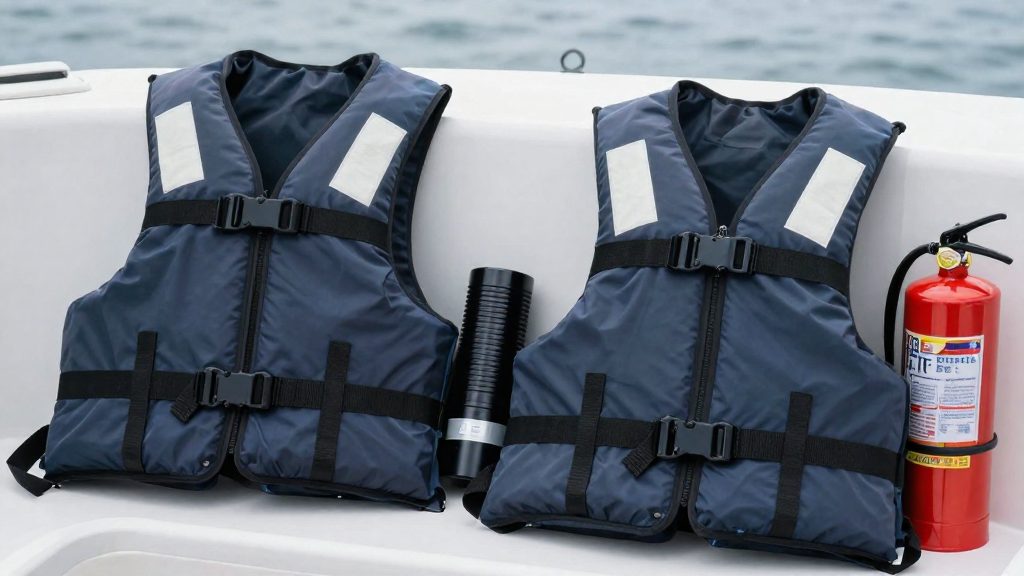
The core federal rule is that at least one wearable personal flotation device (PFD) must be on board for each person. Each device must be used according to its approval label and, where the label refers to one, the owner’s manual (33 CFR 175.15(a)). A throwable device does not count toward this wearable requirement.
Boats 16 feet or more in length must also carry one throwable PFD in addition to the wearable devices (33 CFR 175.15(b)). A throwable device helps a person in the water who can reach it, but it does not replace a wearable device.
Children add a second layer. An operator may not run a recreational vessel underway with a child under 13 aboard unless the child wears an approved PFD or is below deck or in an enclosed cabin (33 CFR 175.15(c)). In practice, have a child-sized PFD ready before the engine starts.
Some craft are exempt. Canoes and kayaks 16 feet or longer do not need the additional throwable device. Racing shells, rowing sculls, racing canoes and racing kayaks are exempt from carrying any PFD, and so are sailboards (33 CFR 175.17). An exemption is a legal point, not a safety recommendation: paddlers who want protection should still wear one.
Choosing the right device matters as much as owning one. Pick a PFD suited to your activity and body size, confirm the approval marking and label, and check that it fits snugly with straps and buckles fastened. Look for tears, broken buckles and compressed or waterlogged foam, and replace any device that is damaged.
When do you need visual distress signals?
Federal rules set distress signals by boat length. A recreational boat 16 feet or more in length must carry visual distress signals suitable for day and night use (33 CFR 175.110(a)). A boat under 16 feet needs only night-suitable signals, and only between sunset and sunrise (33 CFR 175.110(b)). Signals must be selected from the list in 33 CFR 175.130, or from the alternatives in 175.135, and carried in the required number.
The list shows how the categories work. An orange flag meets the day-only requirement, and an electric distress light meets the night-only requirement. Hand-held red flares are a day-and-night device, and the table requires three of them. The pyrotechnic entries carry a footnote requiring a manufacture date of 1 October 1980 or later (33 CFR 175.130).
Flares are the most hazardous item on the list. They burn at high temperature and can cause burns or start a fire on a boat. Store them dry, within reach of an adult but out of children’s reach and away from fuel. Read the label before use, and never fire a device that is damaged or corroded.
Do you need a fire extinguisher?
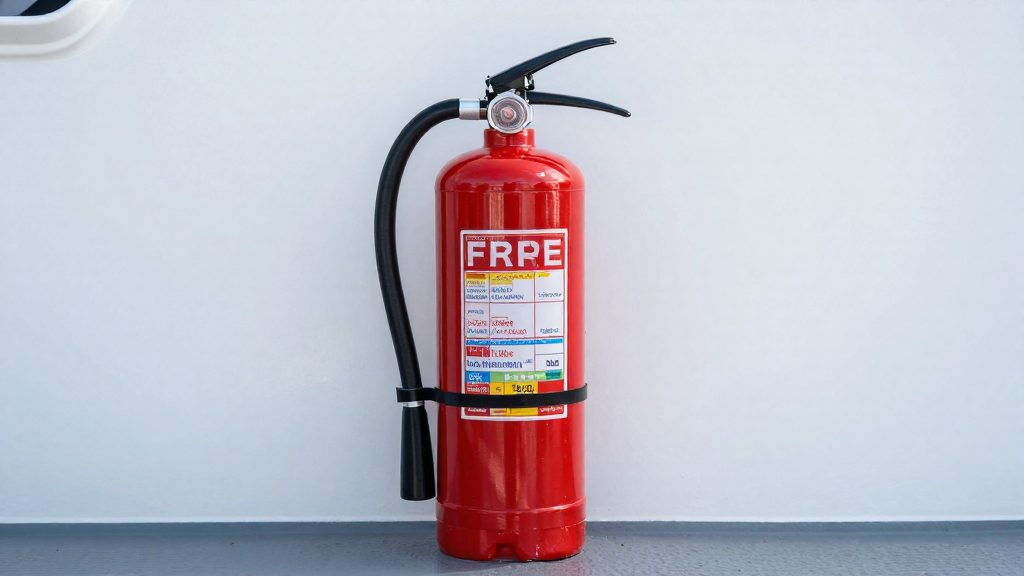
Fire extinguishers are governed by 33 CFR Part 175, Subpart E. Each portable or semi-portable extinguisher must be on board and readily accessible, of an approved type, not expired and not appear to have been previously used, and in good working condition (33 CFR 175.310(a)). Good working condition includes a gauge in the operable range where one is fitted, a firmly seated lock pin, a clear discharge nozzle, and no significant corrosion or damage.
The number depends on boat length and on the engine and fuel layout. A boat under 26 feet propelled by an outboard motor is not required to carry portable extinguishers if its construction will not permit explosive or flammable gases or vapors to become trapped (33 CFR 175.320(a)(1)). Otherwise, the minimum in Table 1 follows length and whether a fixed extinguishing system protects the machinery space. Boats under 16 feet need one 5-B extinguisher without a fixed system and none with one. Boats from 16 feet to under 26 feet follow the same pattern. Boats from 26 feet to under 40 feet need two without a fixed system and one with. Boats from 40 to 65 feet need three without and two with.
Table 2 adds fuel-related triggers. A closed compartment under thwarts and seats where portable fuel tanks may be stored, and a permanently installed fuel tank, each call for an extinguisher. A single 20-B unit may replace two 5-B units, and extinguishers with larger ratings may always be used to meet the table (33 CFR 175.320). Because the table is detailed, confirm your boat’s configuration against the full text before buying or removing equipment.
Sound signals and gasoline engines
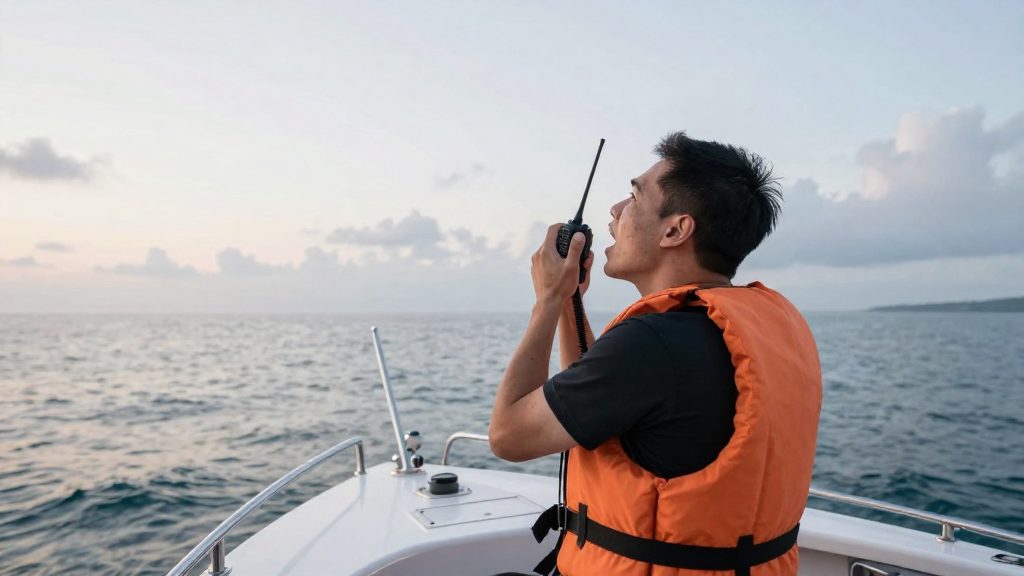
A vessel of 12 meters (about 39 feet) or more in length must carry a whistle (33 CFR 83.33(a)). A vessel under 12 meters is not obliged to carry the whistle, but if it does not, it must have some other means of making an efficient sound signal (33 CFR 83.33(b)). For a small boat, that means a hand-operated horn or whistle within reach of the helm, tested before the season.
Construction rules for ventilation and backfire flame control sit in 33 CFR Part 183 and 46 CFR 25.35. They govern how a boat is built rather than what you carry, so this article does not restate them. For your own boat, follow the engine and ventilation documentation from the manufacturer, and have a qualified marine technician check the system. If you smell fuel, do not start the engine or switch on electrical equipment until the space has been ventilated and the cause is found.
Keeping your equipment ready
Most equipment failures are discovered too late, when the boat is already in trouble. Before every trip, check each PFD for fit and damage, the extinguisher’s gauge, lock pin and nozzle, the expiration dates and packaging of flares, and whether the horn sounds. If an extinguisher’s label warns against freezing, keep it where freezing is not expected (33 CFR 175.310(c)). Show passengers where the equipment is stored and how to use it.
When a device is uncertain, follow the manufacturer’s documentation rather than guessing. Replace anything that is doubtful; the cost of a new device is small compared with the consequences of one that fails when it is needed.
Frequently asked questions
What should I do with a flare that has passed its expiration date?
Do not rely on it. Replace it with a current device, and dispose of the old one through your local fire department or household hazardous-waste program rather than in household trash. Follow any disposal instructions on the label.
Where should I mount the fire extinguisher on a small boat?
Place it where you can reach it quickly from the helm or the engine area, not locked away or buried under gear. The bracket should hold it firmly so it can be removed with one hand. Follow the manufacturer’s mounting and storage instructions.
What should I check after a boat has capsized or been near a fire?
Treat the equipment as compromised. Inspect PFDs for damage, check that extinguishers have not discharged or lost pressure, and replace flares that were submerged or exposed to heat. If you are unsure whether a device is safe, contact the manufacturer before relying on it.