Why distress signals matter
A distress signal tells people nearby, and the rescue system ashore, that you need help now. The signal you choose decides who receives the message. A flare is seen by a boat within sight, a VHF call is heard by any station monitoring the channel, and a beacon alert is relayed by satellite to rescue authorities. Knowing what each signal means, which ones your boat must carry, and how to use them safely is part of seamanship.

Visual distress signals your boat must carry
In the United States, the federal rules for visual distress signals (VDS) are in Title 33, Part 175, Subpart C, of the Code of Federal Regulations. Under 33 CFR 175.110, a boat 16 feet or longer must carry approved visual distress signals for day use, night use, or both, in the required number. A boat shorter than 16 feet must carry signals suitable for night use only, and only between sunset and sunrise. The devices must be chosen from the list in 33 CFR 175.130 or the alternatives in 33 CFR 175.135.
Some people are exempt from the general rule under 33 CFR 175.115. They are competitors in an organized marine parade, regatta, race or similar event; people using a manually propelled boat; and people using an open sailboat under 26 feet with no propulsion machinery. They must still carry night-use signals between sunset and sunrise.
Because state boating agencies can add their own requirements, check your state rules before you leave the dock.
Approved devices and how many to carry
The table in 33 CFR 175.130 lists the devices that count toward the requirement and the quantity of each:
- Hand-held red flare, day and night: three.
- Parachute red flare, day and night: three. Some versions need a launcher approved under 46 CFR 160.028.
- Rocket-propelled parachute red flare, day and night: three.
- Red aerial pyrotechnic flare, day and night: three. Some versions may need a launcher.
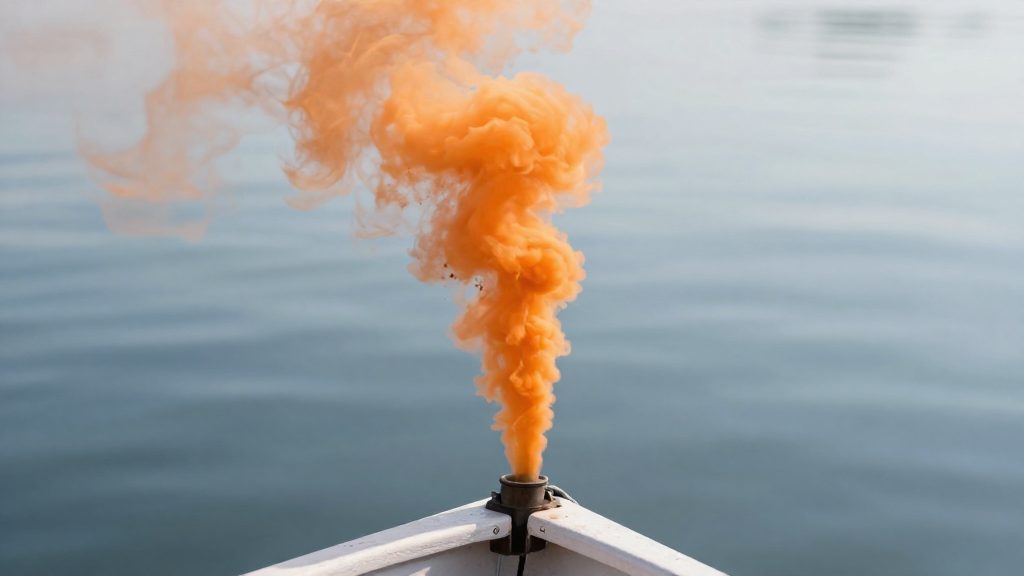
- Hand-held orange smoke and floating orange smoke, day only: three of each type.
- Orange distress flag, day only: one, approved under 46 CFR 160.072.
- Electric distress light, night only: one, approved under 46 CFR 161.013.
Any combination of listed devices can satisfy both the day and night requirements, as long as the required numbers are met. The regulation’s own example is two hand-held red flares plus one parachute red flare.
Orange smoke gives no light, so it is useful only in daylight. A red flare is the choice when you need to be seen after dark. Look for the approval markings on each device, and remember that only devices from the approved list count. Electronic or unapproved gadgets do not replace the listed signals.
Sound, light and flag signals
The international list of distress signals is in Annex IV of the International Regulations for Preventing Collisions at Sea, which the US Coast Guard publishes. These signals apply to US vessels operating under those rules, and they are the signals rescuers expect to see. The list includes:
- repeated gun or explosive signals, at about one-minute intervals;
- a continuous sounding of a fog signal;
- red star rockets or shells, and red flares;
- flames on the vessel;
- orange smoke;
- a square flag with a ball above or below it;
- slowly raising and lowering outstretched arms;
- SOS sent in Morse code, and the International Code flag N.C.;
- the spoken word “Mayday” over the radio;
- digital and satellite distress alerts, EPIRB signals, and approved signals from radiocommunication systems, including survival craft radar transponders.
The same annex states that these signals may be used only to indicate distress. Using them for any other purpose, or using other signals that could be confused with them, is prohibited. Treat each signal as a serious act, and never fire a flare or send an alert as a test or a joke.
Voice calls: Mayday, Pan-Pan and Securité
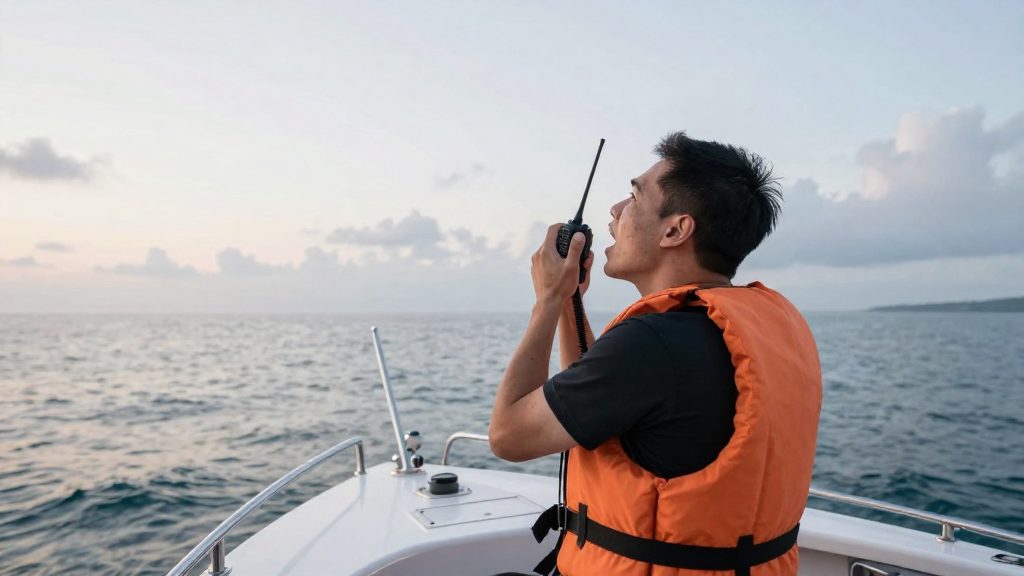
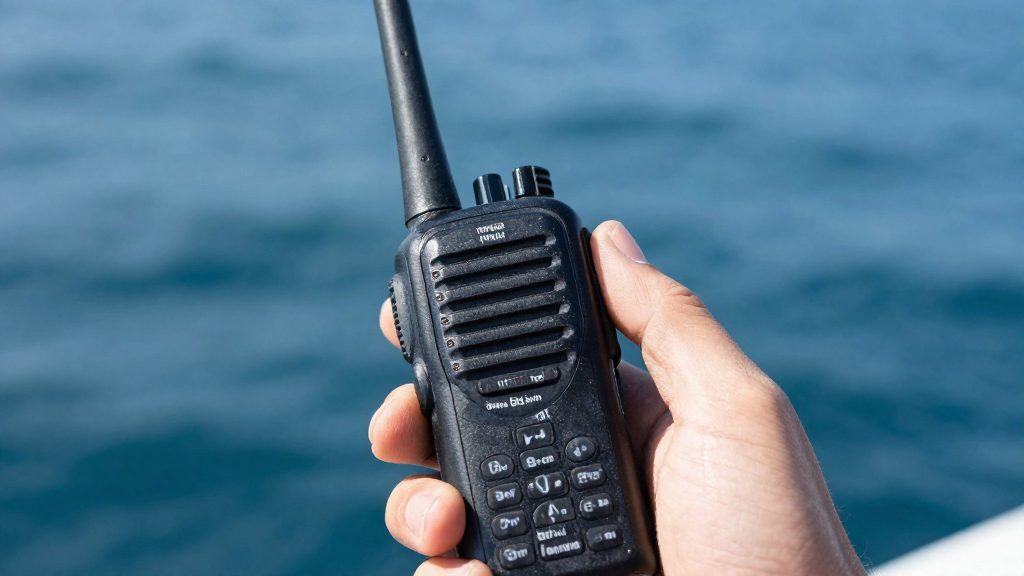
VHF Channel 16 (156.8 MHz) is the emergency channel. Use it unless you are certain you are outside VHF range of shore stations and other vessels.
Mayday is the distress call. Use it only when a person or the vessel is in grave and imminent danger and needs immediate help. The US Coast Guard’s radio guidance is to say “MAYDAY” three times, then the vessel name and call sign or registration number, your position, the nature of the distress, the assistance you need, and the number of people aboard. Finish with “OVER”. Give your position as latitude and longitude when you can, or as a range and bearing from a known landmark when you cannot.
Pan-Pan is the urgency call. It signals that the safety of a vessel or a person is at risk, but there is no immediate threat to life. Typical examples are a crew member who is injured but stable, or a boat that is drifting toward danger and can still be controlled.
Securité is the safety call. Use it for messages about hazards to navigation, such as a danger that other boats need to avoid.
If you hear a distress call that no one answers, the US Coast Guard guidance is that you must answer it.
EPIRBs and digital alerts
An emergency position-indicating radio beacon (EPIRB) is a 406 MHz beacon. Once activated, it sends an alert through the international satellite system (Cospas-Sarsat), and NOAA receives it so that rescue authorities can locate the boat. Digital selective calling (DSC) radios have a dedicated distress function that sends an alert to other equipped stations, and the US Coast Guard lists VHF channel 70 as reserved for DSC distress, safety and calling purposes.
Registration is what turns an alert into a call to the owner’s contact details. NOAA’s registration page says there is no fee, that buyers of a new or used US-coded 406 MHz beacon must register it, and that registration lasts two years, so the owner must re-register every two years. Update the record whenever contact or vessel details change. When you sell a boat, notify NOAA and make sure the buyer registers the beacon in their own name, because rescue authorities may contact the previous owner if the beacon is activated after the sale. Beacons with a non-US country code are registered through the manufacturer or the Cospas-Sarsat website instead.
What to do when you are in distress
- Decide the level of urgency. If a person or the vessel is in grave and imminent danger, call Mayday. If the situation is serious but not immediately life-threatening, use Pan-Pan.
- Make the radio call on Channel 16. Stay by the radio if you can. Transmit so the Coast Guard can take a bearing on your signal if possible, and repeat the call at intervals until someone answers.
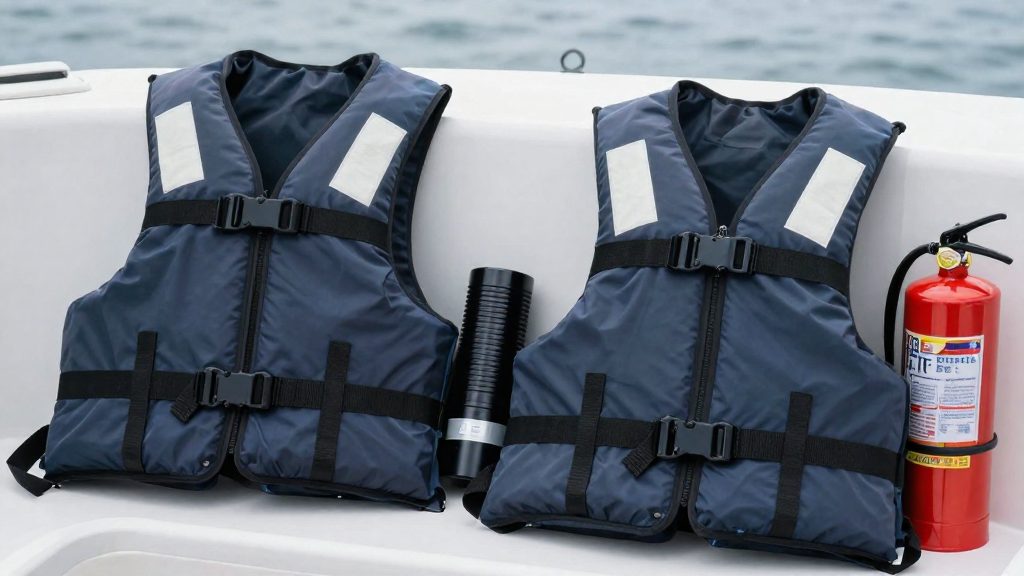
- Keep people safe while you wait. Gather everyone together, put on lifejackets, and move people away from fuel, gas and any fire.
- Activate the EPIRB if the situation is life-threatening. For example, use it if the vessel is sinking or cannot be controlled. Follow the manufacturer’s instructions for the specific unit.
- Use visual signals when a rescue vessel or aircraft is near. Fire flares only when you can see or hear searchers, because a flare is wasted otherwise. Hold pyrotechnics at arm’s length, point them away from people, sails, fuel and the boat itself, and never fire into the wind or in an enclosed space. Keep spent devices in a safe place until they have cooled, and dispose of them as the manufacturer says.
- If no one answers, switch to a high frequency channel guarded by the Coast Guard, repeat your call, and keep the EPIRB ready if the situation worsens.
- After rescue or when the danger has passed, tell the responding authority that you are safe, so that resources are released and no one keeps searching for you.
Keep your signals ready
A signal that fails when you need it is useless. Check each device before every season and before long trips. Look at the expiry date and the condition of the casing, and replace any flare that is out of date, damaged or wet. Keep the devices where you can reach them quickly, not in a locked locker or under other gear. Store them dry, away from heat, and keep the instructions with them. A launcher, if your flares require one, belongs with the flares.
For the EPIRB, follow the manufacturer’s instructions for testing and battery replacement. NOAA’s registration pages link to guidance on testing 406 MHz beacons and on preventing false alerts, and you should read that guidance once a year. Practise the radio call with the microphone switched off, so that the words come out clearly when they matter.
Summary of the core rules
The rule for your boat is set by its length and the time of day. Mayday is for grave and imminent danger, Pan-Pan for urgency, and Securité for navigation safety. Use Channel 16 for voice calls, the EPIRB for life-threatening situations, and visual signals when rescuers are close enough to see them. Keep every device approved, in date and within reach.
Frequently asked questions
Can I use my VHF radio instead of carrying flares?
The visual signal rule in 33 CFR 175.110 requires devices chosen from the approved list in 33 CFR 175.130 or 175.135, so a radio does not replace those devices where the rule applies. A radio is still the main tool for calling for help, so carry both and keep the radio working.
What should I do if my EPIRB is activated by mistake?
Contact the Coast Guard on Channel 16 or by phone as soon as possible to report that the alert is false, and follow the manufacturer’s instructions for the specific unit. NOAA warns about false alerts, and rescue authorities may respond to an activation even when it was accidental.
Are expired flares still useful?
Do not rely on them. A device past its marked date or with damage may not work, and the approval markings and manufacturer’s instructions are the only reliable guide. Replace expired devices, and keep the old ones out of the boat’s ready stowage.