What Is the Marine Radio Distress Call Format?
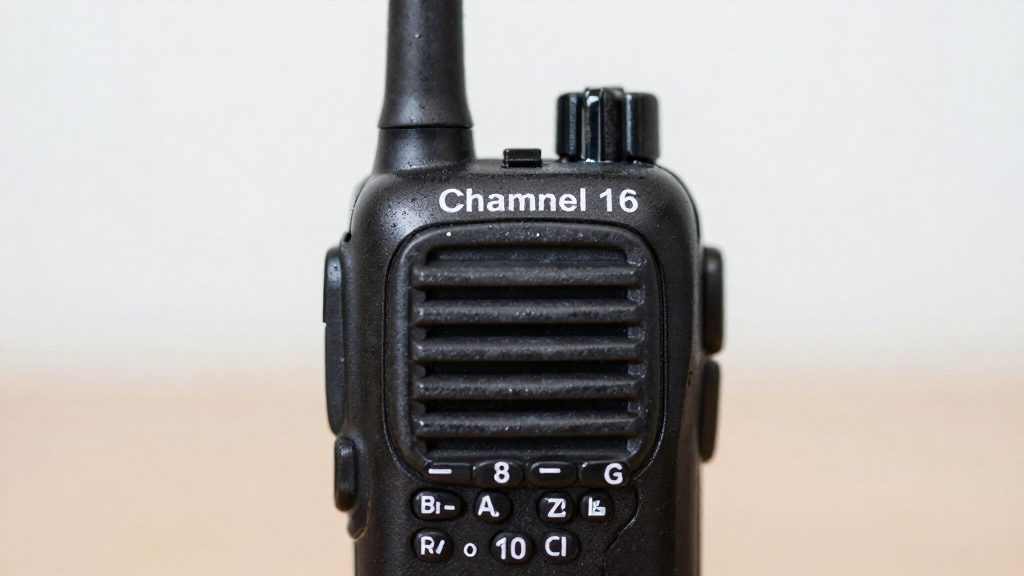
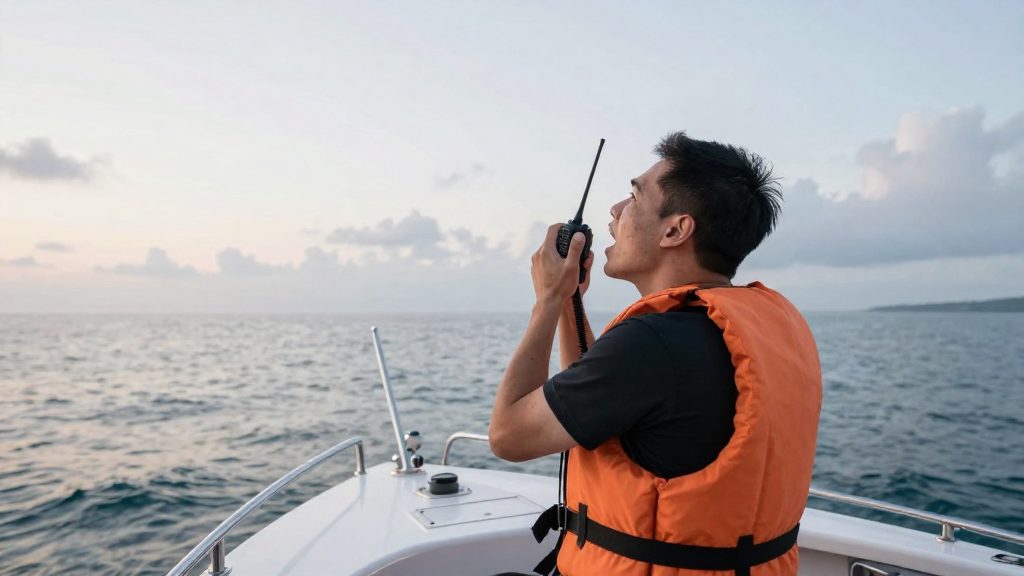
A distress call is a short, fixed sequence that lets rescuers and nearby boats understand your situation within seconds. The U.S. Coast Guard describes VHF-FM as the preferred way for a vessel on the water to report an emergency, and it directs callers to Channel 16 (156.8 MHz) for that purpose.
The format has three parts: a signal word that sets the level of urgency, the identity of your boat, and the information that lets someone find you and judge what help you need. Speak slowly and calmly. A complete, clear call is worth more than a fast, garbled one, because responders can only act on what they actually receive.
When Should You Use MAYDAY, PAN-PAN or SECURITE?
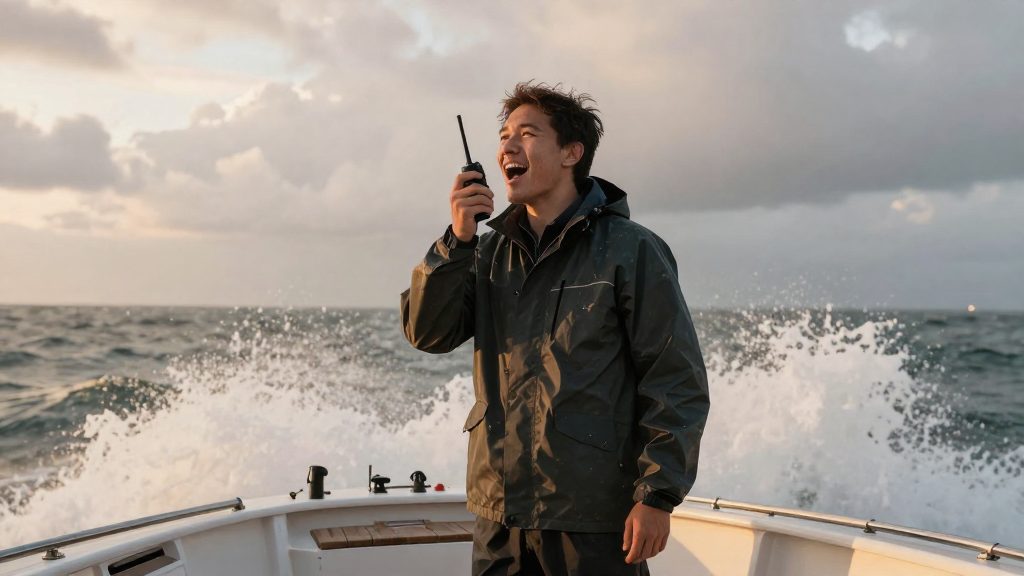
Choosing the right signal word matters, because it tells responders how quickly they must move.
MAYDAY is reserved for grave and imminent danger to your vessel or to someone on board, where immediate assistance is required. Examples include flooding you cannot control, a fire on board, or a serious injury when you have no safe way to get help.
PAN-PAN is for urgent situations that are not immediately life-threatening. A person overboard, a boat drifting toward shore or into a shipping channel, or a controllable leak are typical cases. Use PAN-PAN when you want help on standby in case the situation gets worse.
SECURITE is a safety message, not a distress call. Use it to warn other vessels about navigation hazards, such as a large commercial vessel in a narrow channel or an approaching severe storm.
If you are unsure whether life is at risk, treat the situation as a MAYDAY. Under-calling a real emergency is far more dangerous than over-calling one.
How Do You Make a MAYDAY Voice Call?
Follow this sequence, and keep your notes or a laminated card at the helm so you can read it under stress.
- Prepare the radio. Turn it on, select Channel 16, and set output to high power.
- Key the microphone. Press and hold the transmit button, hold the microphone a short distance from your mouth, and speak slowly.
- Declare the distress. Say “MAYDAY” three times. The Coast Guard’s own published steps open with “MAYDAY MAYDAY,” so use the wording your radio course taught you and stay consistent.
- Identify your vessel. Say “THIS IS,” then the vessel name, repeated for clarity, followed by the call sign if you have one. For example: “This is Lucky Star, Lucky Star, Lucky Star.”
- Give your position. Use latitude and longitude if your chartplotter or handheld GPS provides them. If you do not have a fix, describe your location by bearing and distance from a landmark that appears on your chart.
- Describe the emergency. Say what is happening, such as sinking, fire or a man overboard, and what kind of help you need.
- Report people and injuries. State the number of people aboard and any injuries or medical conditions that affect the response.
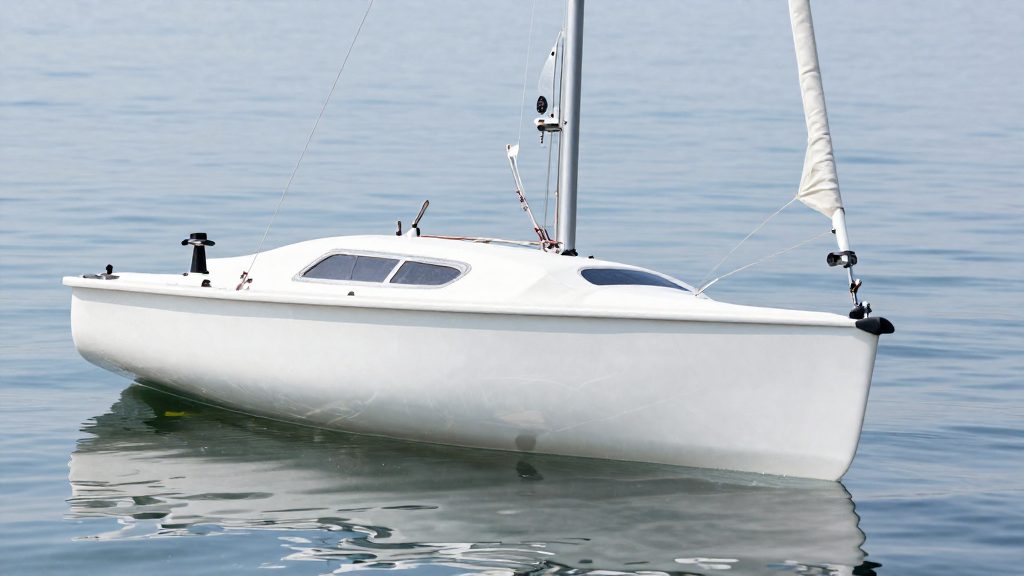
- Describe the boat. Give the length, hull type and hull color. Responders use this to spot you from a distance.
- Release and listen. Let go of the button and wait for a reply. Keep the handset close, and do not leave the channel.
Repeat the essentials, especially your position, if you have time. Responders may be receiving from far away or in poor conditions, and a repeated position can make the difference.
What If Nobody Answers?
The Coast Guard advises waiting about 10 seconds after releasing the transmit button. If there is no response, repeat the call.
If you still get no answer, keep the call going as long as your radio works, and include your position each time. If possible, switch to other channels and interrupt routine traffic with your MAYDAY. If you hear no traffic at all, try Coast Guard Channel 22A.
While you are transmitting, keep the call brief and focused. Do not stop to explain the cause of the problem, and do not spend airtime on questions that do not help the rescue.
Why Does Transmit Power Matter?
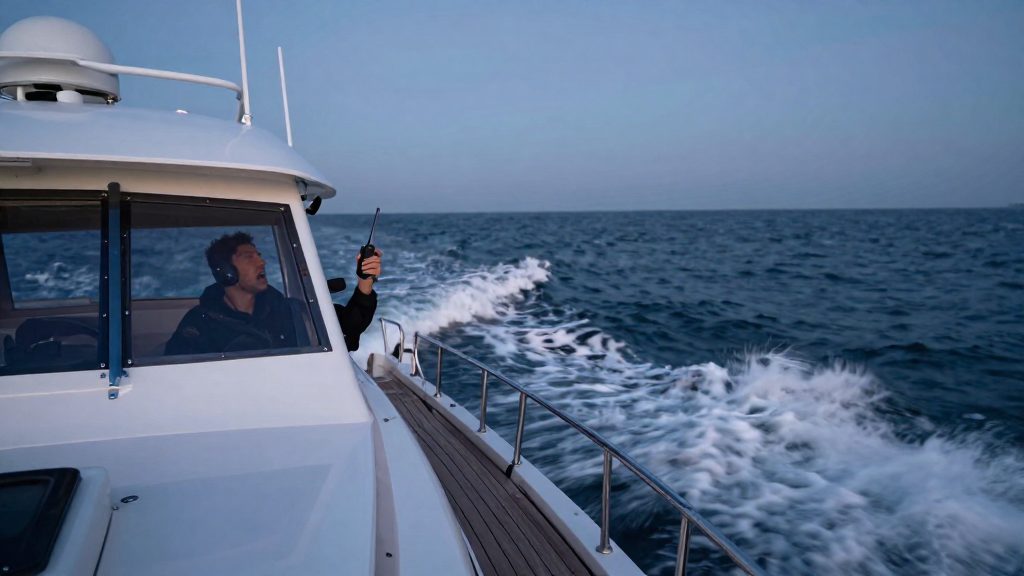
The federal rule for maritime VHF stations sets the maximum transmitter output for ship stations on 156–162 MHz at 25 W. A footnote allows that output to be reduced to 1 W or less, except for certain automated public correspondence systems.
In practice, use the high-power setting for a distress call so your signal reaches the widest possible audience. Switch to low power for routine, short-range calls to conserve battery and reduce interference. A handheld set makes the same call on the same channel, so keep a spare battery charged and carry it on board.
How Does a DSC Distress Alert Work?
A Digital Selective Calling (DSC) radio can send a silent digital distress alert with a single, guarded button. The alert carries your nine-digit Maritime Mobile Service Identity (MMSI) and, if the radio is connected to a working GPS receiver, your position.
The Coast Guard stresses that accurate information matters. Out-of-date MMSI registrations, and alerts with invalid or missing positions, make it harder to tell a real emergency from an accidental activation. Keep your registration and emergency contact details current, and remember that inaccurate MMSI use is a violation of FCC rules.
To activate the alert, lift the protective cover and press and hold the distress key for the period your radio’s manual specifies. Do not guess the hold time. After the alert is sent, follow the radio’s prompts, and be ready to give the same information by voice on Channel 16.
What Are the Legal Risks of a False Distress Call?
Federal law treats false distress calls as serious crimes. Under 14 U.S.C. § 521(c), a person who knowingly and willfully communicates a false distress message to the Coast Guard, or causes it to attempt to save lives or property when no help is needed, is guilty of a class D felony. The same provision makes that person subject to a civil penalty and liable for all costs the Coast Guard incurs in responding.
Never use the distress key or a MAYDAY call to test your radio. A false alert can send rescue crews and aircraft into the field for nothing, and it can leave a real emergency waiting for help.
Frequently asked questions
Can I make a MAYDAY call on a handheld radio?
Yes. A handheld VHF radio can make the same voice call on Channel 16. Select high power, hold the transmit button, and follow the same sequence. Keep the battery charged.
What should I do if I hear someone else’s MAYDAY?
Stay off the channel unless you can add useful information or you are asked to respond. Note the position and details, keep listening, and be ready to help if the Coast Guard or another vessel asks for assistance.
What if I press the DSC distress key by accident?
If your radio allows you to cancel the alert before it is sent, cancel it. If it has already been sent, contact the Coast Guard on Channel 16 and tell them the alert was accidental so they do not launch a response.