What Channel 16 is for
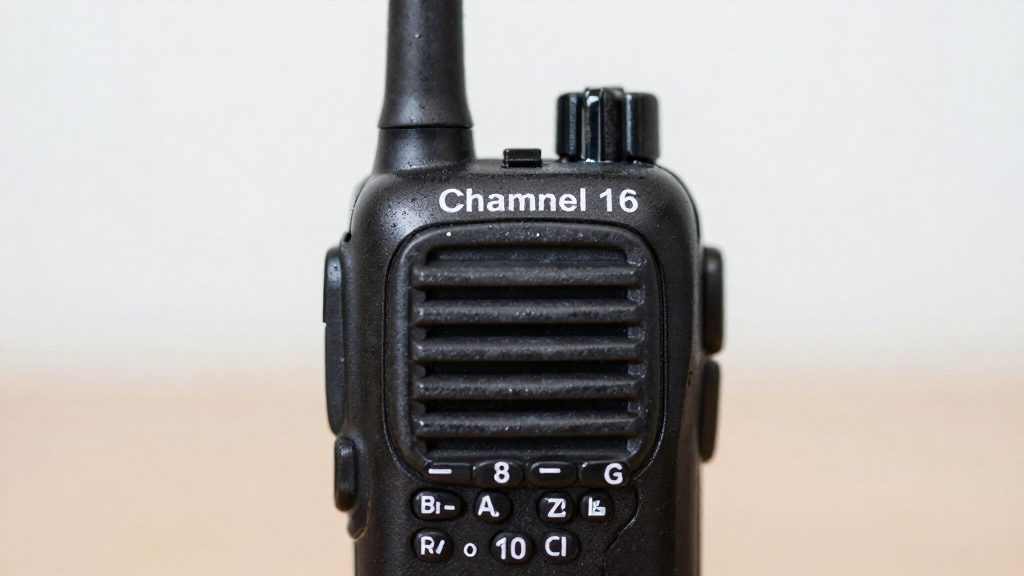
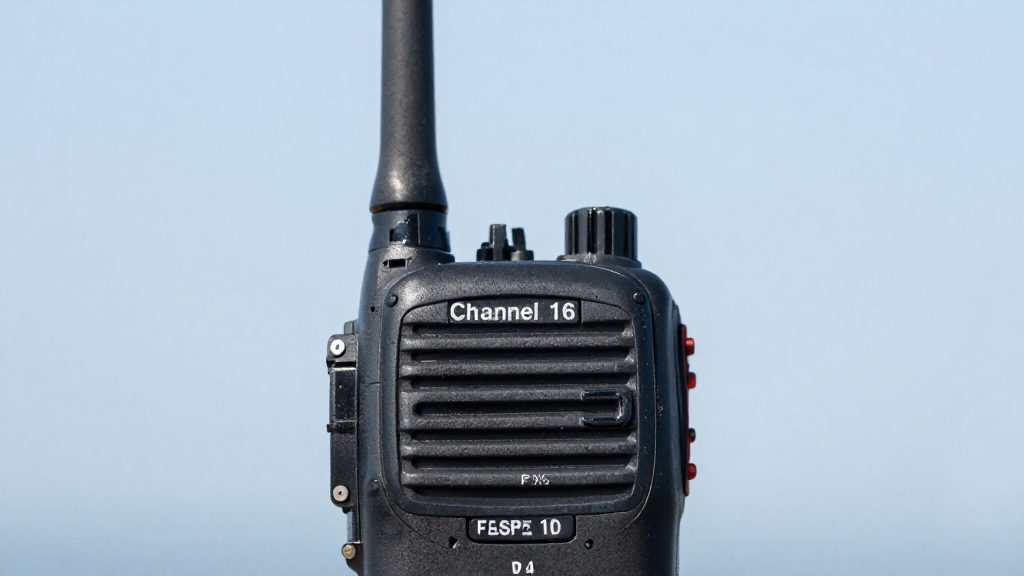
Channel 16 (156.800 MHz) is the international marine VHF channel for distress, urgency, safety, and calling. Under FCC rules it is designated as the international radiotelephone distress, urgency, safety, call and reply frequency for ship, public and private coast stations. The same rules state that distress, urgency and safety calls should initially be made on 156.800 MHz.
In practice, Channel 16 has three jobs. It is where you start a distress call. It is where you make a brief first contact with another vessel or a shore station when you do not yet know which channel they will use. And it is where the Coast Guard broadcasts urgent information: storm warnings and other urgent marine broadcasts go out on Channel 16 before they are repeated on Channel 22A.
Channel 16 is not a conversation channel. Everything else on the radio, including longer exchanges, belongs on a working channel.
The rules that apply to you
Most recreational boats operating in US waters do not need an FCC ship station license for a VHF radio, and the Coast Guard’s guidance on MMSI numbers notes that non-compulsory vessels in US waters do not need one. Some vessels are different. A license is still required for a vessel that must carry a radio by law, and for certain other categories of operation. International voyages can change your situation, so check the FCC’s ship station licensing pages before you cross a border.
If your radio has DSC (digital selective calling), each radio on the vessel must use the same, identical MMSI, a nine-digit number that identifies your boat on the DSC system. The Coast Guard’s MMSI page lists the approved organizations that assign these numbers to recreational vessels. Program the number into the radio before you transmit on DSC, and update your registration or reprogram the radio when the boat or radio changes hands.
Watch requirements depend on your equipment and where you operate. Under 47 CFR 80.148, compulsory vessels must keep a watch on 156.800 MHz while underway, with exemptions for vessels using only handheld bridge-to-bridge radios and for certain vessel traffic service participants. Whether your boat is compulsory is a question of federal rules, not of habit, so check the rule text or ask the Coast Guard before assuming you are exempt. Whatever your legal status, keeping Channel 16 on while you are underway with the radio powered is what allows other boats and the Coast Guard to reach you in an emergency.
Finally, false distress traffic is a serious matter. The Coast Guard states that every hoax, including a MAYDAY radio check, is subject to prosecution as a Class D felony. Some boaters who cannot get a radio check on Channel 16 transmit a MAYDAY instead, and that is exactly what must not happen.
Channel 70 and Channel 16 are not interchangeable
Channel 70 (156.525 MHz) is authorized exclusively for distress, safety and calling purposes using digital selective calling. Its function is to send and receive DSC alerts, not to carry voice. Many newer radios have a dedicated DSC distress button. Use it according to your radio’s manual, then follow up with a voice call on Channel 16, because a DSC alert tells the receiving stations that you need help but does not replace the spoken message that tells rescuers where you are and what is wrong.
Do not test your DSC function on a live channel with a MAYDAY. Use the test procedure described in your radio’s manufacturer documentation, and avoid transmitting test traffic on Channel 16.
How to make a Mayday call
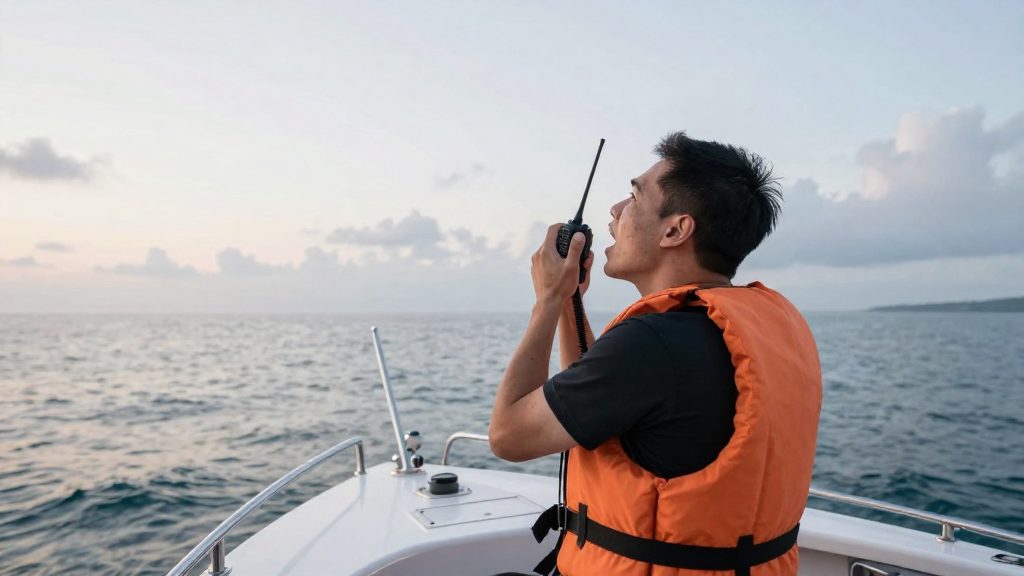
Use a Mayday only when a vessel or person is in grave and imminent danger and needs immediate assistance. The Coast Guard’s procedure for a voice Mayday on Channel 16 is clear and specific:
- Tune the radio to Channel 16 and set the transmit power to high.
- Say MAYDAY three times.
- Say THIS IS once.
- Say your vessel name three times, then your call sign or registration number once.
- Say MAYDAY and the vessel name once more.
- Give your position, the nature of the distress, the assistance you need, and the number of people aboard, plus any other useful details. Use your position relative to a known landmark if you cannot give coordinates, and give your course and speed if you are moving.
- Finish with OVER.
Repeat the call at intervals until someone answers, and stay by the radio if you can. If you hear no answer, the Coast Guard advises using an HF radiotelephone on a Coast Guard-guarded channel and activating your EPIRB, if you have one. Speak slowly. A calm, clearly spoken Mayday is more useful to the rescue service than a fast, panicked one.
If you are in a less serious situation, such as a disabled vessel that is not in immediate danger, use Pan-Pan instead. Pan-Pan is the urgency signal: it means a serious problem that does not, at the moment, threaten life. Sécurité is the safety signal for navigational or weather warnings that other vessels need to know about. Both begin on Channel 16, and both are used with discipline. Do not use them for convenience or to get attention.
If you hear a distress call
If you hear a distress message from another vessel and it is not answered, the Coast Guard’s guidance is that you must answer it. Stay off the channel for the duration of the call so the distress can be heard, and if you are a vessel that can help, identify yourself and say what you can do.
Do not join a distress exchange unless a station in distress or the Coast Guard has asked you to. Your job is to keep the channel open, not to talk over the traffic.
Calling another boat on Channel 16
Channel 16 may be used to call a ship or shore station, but the call must be brief. Make the call on Channel 16, and as soon as the other station answers, agree on a working channel and move there. Once you have finished, return to Channel 16 and listen, because the Coast Guard recommends that boaters normally keep a radio tuned to Channel 16 in their waters unless they are told otherwise.
A typical brief call names the station you are calling, your own vessel name, and the working channel you propose. Keep the full exchange, including the weather and your fishing report, off Channel 16.
Keeping Channel 16 clear
Channel 16 is shared by everyone who may need to make a distress call. Crowded or cluttered traffic can delay a real emergency. Avoid radio checks on Channel 16, since a check is not what the channel is for. If you need a check, use a method the Coast Guard supports, such as a DSC radio check or a coast station check on HF, as set out in its guidance.
If you accidentally transmit on Channel 16, stop at once, and keep listening before you speak again. Do not repeat the transmission to correct it. If a correction is necessary, make it short and clear, then switch to a working channel.
Equipment checks before you go out
A Channel 16 protocol only works if the radio works. Before departure, check the radio’s power, the antenna and its connections, and the battery condition. Keep a backup means of communication, such as a handheld radio with its own charged battery, and know where it is stored. If your boat carries an EPIRB, check that it is registered and that you know how to activate it. For specific maintenance steps, the manufacturer’s instructions for your radio, antenna and battery are the authoritative source.
The habits that matter most are simple. Keep the radio on Channel 16 while underway, know the Mayday sequence before you need it, and practice reading your position off a chart or chartplotter so that the information you give is accurate when it counts.
Frequently asked questions
What should I do if I accidentally transmit on Channel 16?
Stop transmitting immediately and listen before you speak again. If a correction is needed, keep it short and clear, then move to a working channel. Do not repeat the transmission to fix the mistake.
Can I use a phone instead of a VHF radio to call for help on the water?
Phones can be useful as a backup, but they do not replace the VHF radio. Coverage is limited offshore and the Coast Guard does not monitor phone calls the way it monitors Channel 16. Keep the radio as your primary emergency link.
What if my radio battery or antenna fails during a trip?
Use your backup radio if you carry one, and move toward help while you still have communication. Check the manufacturer’s manual for battery and antenna troubleshooting, and carry spare charged batteries for any handheld radio you rely on.