How often should you change boat engine oil?
The engine manufacturer sets the oil and filter interval, and the figure in your owner’s manual is the one to follow. Many schedules count running hours and calendar time together and apply whichever comes first, so a boat that barely leaves the dock still needs its yearly service. If you cannot find the schedule, ask a dealer or the manufacturer for the figures for your exact model and year. Forum posts and general articles often quote numbers, but they do not replace the documentation for your engine.
Two points need particular attention. The first is the break-in change. Many manufacturers call for an early oil and filter change, because a new engine sheds machining debris and wear particles during its first hours. The manual gives the hour value. The second concerns used boats. If you buy a boat and the early service was never recorded, change the oil and filter as soon as possible and look at the old filter for metal particles or debris. Those particles tell you about internal wear.
Why change the oil before winter storage?
An engine that sits for months does not stay clean. While it runs, combustion byproducts, unburned fuel and water vapor mix into the crankcase oil. Running the engine warm drives off part of that moisture, but a stored engine cools and keeps what remains, and the resulting acids and water attack bearings and internal surfaces. Plan the oil and filter change at the end of the season, before storage, not in spring. Storing with fresh oil gives you a clean start next season. Use the same visit to check the lower unit for water, which can freeze and crack the gearcase.
When should you shorten the interval?
Some conditions use up oil faster than the standard schedule assumes:
- Operation in saltwater or brackish water, where salt and cooling-water contamination add risk.
- Frequent short runs that never bring the engine fully up to operating temperature, which lets condensation build up.
- Prolonged trolling or low-speed running, which keeps the engine lightly loaded but below the temperature that drives moisture out.
- Heavy towing, such as wakeboarding, or other sustained high-load use.
- Long idle periods between outings.
When one of these applies, follow the manufacturer’s severe-use schedule if the manual provides one. If it does not, change the oil sooner than the standard interval and check the dipstick before each outing. Milky or foamy oil indicates water in the system, and a change in the oil level between checks needs an explanation before the engine runs again.
How do you choose the right marine oil?
Use the grade your manual specifies. The National Marine Manufacturers Association created the FC-W category specifically for marine four-stroke engines, including inboard, outboard and sterndrive types. Oils seeking this certification pass bench tests for viscosity, corrosion, filter plugging, and foaming and aeration, plus a 100-hour engine test. NMMA licenses the formulations that pass and registers the approved products. Automotive oil is not designed around the duty cycle of a marine engine, which runs long hours at varying loads in wet conditions, so do not substitute it unless the manufacturer approves it.
If your engine has a catalytic converter, the manual will say whether it requires the catalyst-compatible FC-W (CAT) grade. Use exactly the designation the manual lists.
How do you change the oil safely?
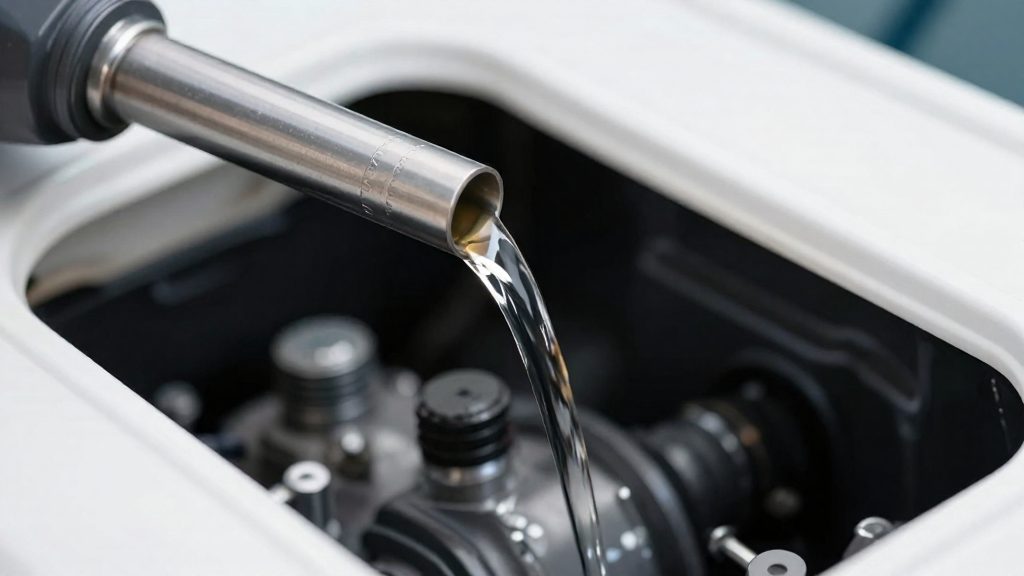
Run the engine briefly so the oil flows freely, then shut it off and let it cool until the exhaust and manifold are safe to touch. Hot oil and exhaust parts cause serious burns. Work on level ground with the engine secured, the ignition off and the key removed. Place a drain pan under the drain plug or drain line. Replace the filter with the part specified for your engine, wipe the sealing surface, lightly coat the new gasket with clean oil, and tighten it to the torque in the manual. Refill to the level marked on the dipstick, not to a volume printed on a container.
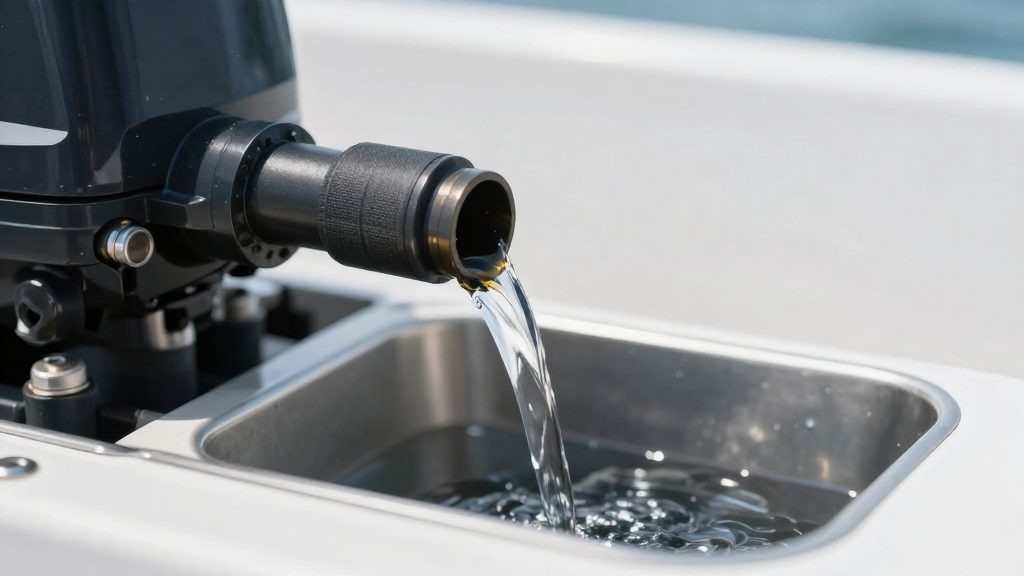
Start the engine only as the manual allows. An outboard must have cooling water supplied through a test tank or flushing connection, because running it out of water can overheat and damage the cooling system. After the run, check the filter and drain plug for leaks, let the engine rest for the time the manual specifies, and check the level again.
Store used oil in a sealed container and take it to a marina, service shop or local collection site that accepts it. Never pour it overboard, into a storm drain or into the bilge. Disposal rules vary by state and locality, so confirm them with your local environmental agency.
What are the federal rules for oily bilge water?
The Clean Water Act prohibits discharging oil into navigable waters of the United States in harmful quantities. EPA’s sheen rule, codified at 40 CFR Part 110, sets the criteria for harm. A discharge is harmful when it causes a sheen or discoloration on the water surface or adjoining shorelines, or when it leaves sludge or emulsion beneath the surface or on shorelines. Federal law also provides civil penalties for violations.
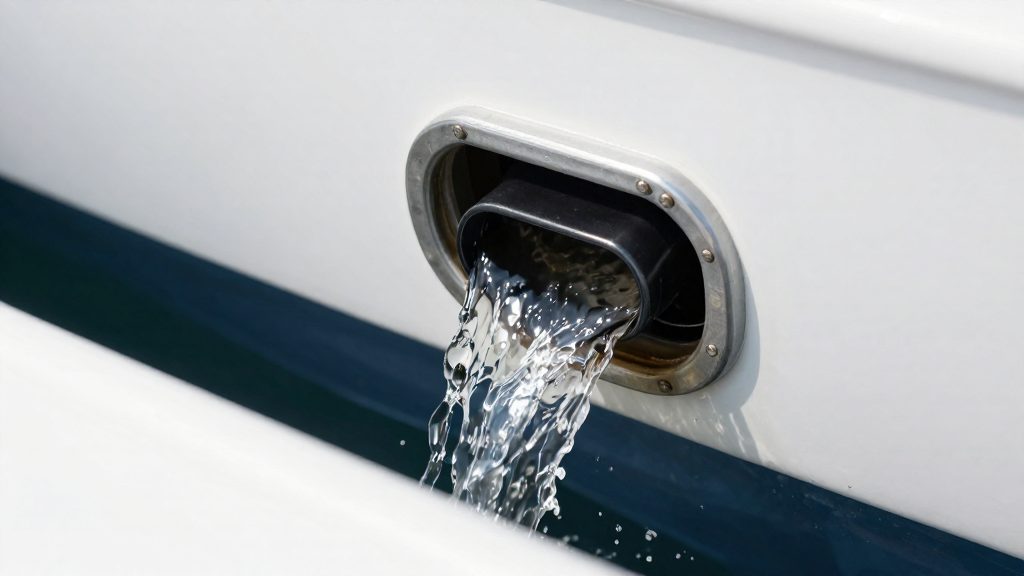
In practice, inspect the bilge before pumping it. If you see a sheen, do not pump it overboard. Use absorbent pads under the engine and in the bilge, and check that they do not interfere with the float switch that starts the pump. Dispose of saturated pads and oily water through an approved channel, following local rules.
The Coast Guard placard rule in 33 CFR 155.450 covers ships of 26 feet or more in length. Where it applies, the placard must be at least 5 by 8 inches, made of durable material, and fixed in a conspicuous place in each machinery space or at the bilge and ballast pump control station. If your boat is shorter, that section does not apply, but the discharge rules above still do.
Frequently asked questions
What does milky or foamy oil on the dipstick mean?
It usually means water has entered the oil, through condensation or a leak. Do not run the engine until a qualified mechanic has found and corrected the cause.
Must a dealer perform my first oil change?
Not always, but some warranties require documented factory-interval service. Read the warranty terms and the owner’s manual before you do the work yourself, and keep records of every change.
Do I have to report a small sheen from my bilge?
Report any discharge that may be harmful to public health or welfare. Under EPA’s sheen rule, a sheen on the water is one of the criteria for harm, so contact the National Response Center and follow EPA guidance.