What the US rule requires
If you own a recreational boat in the United States, the U.S. Coast Guard sets the minimum number of portable fire extinguishers you must carry. Three factors decide the count: the boat’s length, whether the engine space has a fixed fire extinguishing system, and the model year of the boat. Other authorities, such as a state agency or a marina, may set their own requirements, so confirm those before you head out.
How many extinguishers you need by length
The counts below apply to portable units rated 5-B or 20-B, the ratings the Coast Guard lists for these boats.
| Boat length | No fixed system in engine space | Fixed system in engine space |
|---|---|---|
| Under 26 ft | 1 | 0 |
| 26 ft to under 40 ft | 2 | 1 |
| 40 ft to 65 ft | 3 | 2 |
When the engine space has a fixed system, the required count is one unit lower in every length band. Count the fixed system only if it is actually installed in the engine space, and confirm its inspection and service requirements with the manufacturer’s documentation.
When a small boat may be exempt
A motorized boat under 26 feet may be exempt from carrying an extinguisher, but only if all three conditions apply. The boat must have an outboard engine, carry its fuel in portable tanks, and have no areas where fuel vapors can be trapped. If any one condition is not met, the exemption does not apply. Even when you are exempt, a compact unit is still a sensible precaution on a small boat.
Ratings: B-I, B-II, 5-B and 20-B
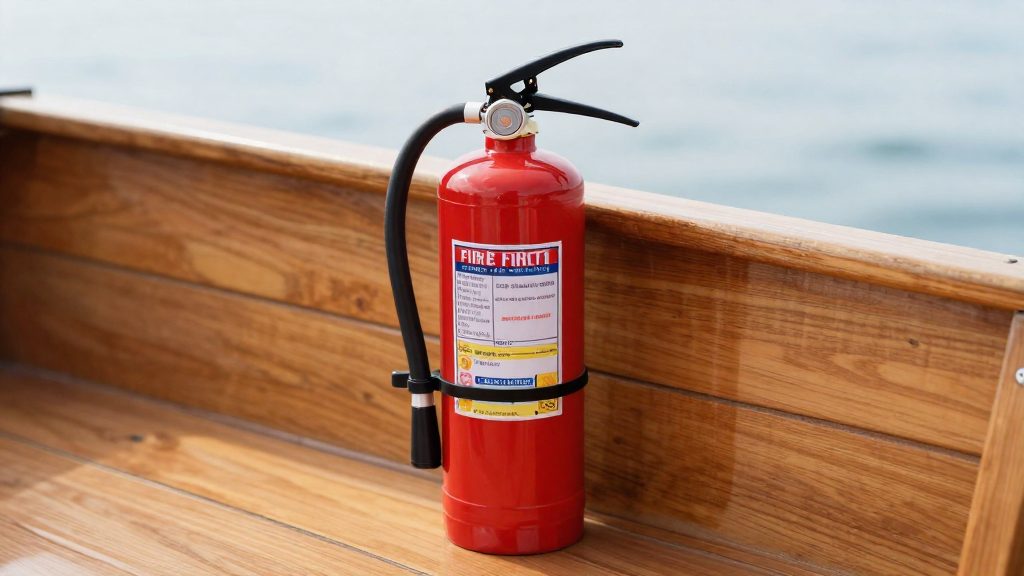
The letter and number on a label describe the fire class and the relative size of the unit. The letter B refers to fires involving flammable liquids such as gasoline, which are the main fire risk on most recreational boats. The number indicates relative capacity: a higher number means a larger unit.
The Coast Guard treats some ratings as equivalent. One 20-B unit can replace two 5-B units. A 10-B unit counts as only one 5-B, and it does not replace two 5-B units. A boat that needs two 5-B units therefore cannot meet the requirement with a single 10-B unit. Always read the rating on the label itself, not the size of the bottle, before counting a unit.
Model year and date stamps
Boats of model year 2018 and newer must carry 5-B or 20-B units that are date stamped. Boats from model years 1953 through 2017 have more options. They may carry B-I or B-II units, which do not need a date stamp if they are in good, serviceable condition. For 5-B or 20-B units on these older boats, the Coast Guard FAQ describes the unit as either undated or no more than 12 years old. If you are unsure which applies, look for a date stamp and check it against the 12-year limit below.

How long an extinguisher lasts
Disposable, non-rechargeable units must be removed from service 12 years after the manufacture date stamped on the bottle. Rechargeable units have no 12-year limit, but they need upkeep. Their first NFPA-certified inspection is due one year after the manufacture date, and a technician must maintain them every year.
An expired unit may stay aboard only if a compliant, newer extinguisher is also carried. Between professional services, check the pressure gauge and the label on a regular schedule. Follow the manufacturer’s documentation for the correct gauge readings and the required service intervals, because these vary by product.
Mounting and access
The Coast Guard strongly recommends mounting each portable unit, although mounting is not required. Whether or not a unit is mounted, it must be readily accessible. Do not store it in a locked cabinet, under a pile of gear, or in a locker that takes effort to open. A bracket near the helm and near the engine space is a common arrangement, and the unit should be kept away from direct engine heat and sun, as the manufacturer directs.
Before you leave the dock
Run through this checklist before each trip:
- The number of units matches your boat’s length and whether a fixed system is installed in the engine space.
- Each label shows a qualifying rating: 5-B, 20-B, B-I or B-II, and the combined counts meet the table above.
- A boat of model year 2018 or newer has date-stamped units, and no unit is past its 12-year limit.
- Each gauge is in range, and no unit is dented, corroded, or obviously damaged.
- Every unit is reachable from the helm and from the engine area while underway.
- Everyone aboard knows where the units are and how to operate them by following the steps on the label.
If a unit has been discharged, dropped, or damaged, have it inspected or replace it before you rely on it.
Frequently asked questions
Do these rules apply outside the United States?
No. The counts and dates described here come from the U.S. Coast Guard. Other countries set their own equipment rules, so check with your national maritime authority before you sail abroad.
How do I dispose of an expired extinguisher?
Do not put it in household trash without checking first. Ask your local fire department, marina, or hazardous-waste program which disposal options are available in your area.
What should I do if the pressure gauge is out of range?
Do not rely on the unit until a qualified service technician has inspected it. Follow the manufacturer’s documentation for the correct gauge readings and the service steps.