
To check a fiberglass hull for gelcoat cracks, work in good light on a clean, dry surface, and read the pattern before judging severity. Stress cracks are localized and follow the structure, while crazing is a random network spread over large areas. Then press on suspect areas, tap them to listen for dull sounds, and check whether any part of the hull moves under light hand pressure. Cracks that cluster, run in one direction, sit near hardware, or come with a soft or flexing area should be treated as a possible laminate problem, and the boat should not be used until a qualified person has assessed it.
How do you prepare the hull before looking for cracks?
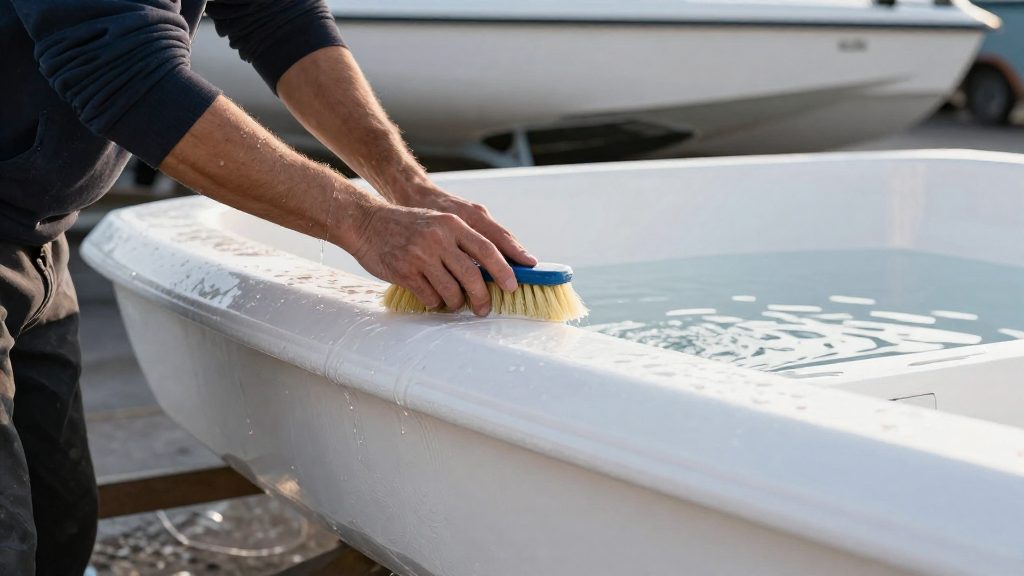
Fine cracks are easy to miss on a dirty or dull surface. Wash the hull with fresh water and a mild detergent, rinse it, and let it dry completely, because salt film, wax residue and old scuff marks can hide hairline lines. Work in daylight or under a strong lamp held at a low angle. Raking light casts a small shadow into a shallow crack, which makes it visible when a flat light would wash it out. Get close to the surface and move your head slightly, since the eye needs a moment to pick out a pattern at close range.
If the boat can be hauled out, inspect it on stands or in a cradle. Support it evenly, as described later in this article, and you will be able to see the underside of the cracked area as well as the top. Work from the top of the hull downward, so that runoff does not dry on areas you have already checked.
What do stress cracks look like compared with crazing?
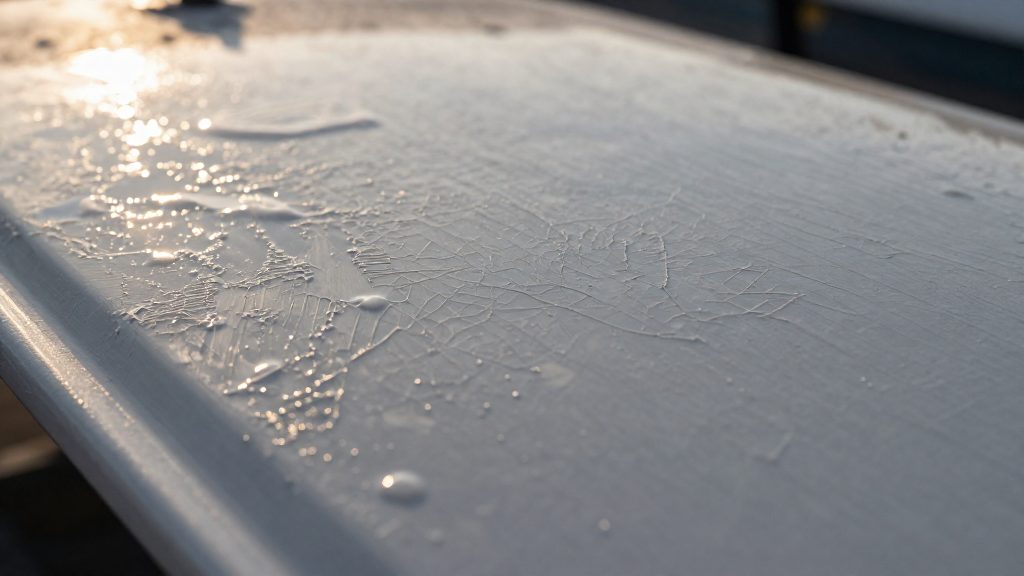
According to Practical Sailor, fiberglass generally reveals stress problems through cracks in the gelcoat, and those cracks can be very fine and hard to see. Stress cracks are localized, and they usually have an identifiable pattern to a trained eye. A cluster of cracks that all run in the same direction indicates a more serious problem than a few isolated lines. A resin manufacturer’s technical article notes that such clusters often appear at the leading edge of the cabin top.
Crazing is different. It is a random network of short cracks that can cover an entire deck. The same manufacturer’s article attributes it to the gelcoat expanding and contracting with changes in temperature. Because a deck-wide network is a different question from a few stress cracks at one fitting, sort the cracks by pattern and location before deciding what to do. Do not assume that a widespread network is harmless just because it is cosmetic in appearance.
Where should you look first on the hull?
Start where the structure is loaded most. Check the chain plates and the deck areas around them, the bow roller, cleats, stanchion bases and any other heavy hardware. Rigid gelcoat tends to crack where fittings pull on and flex the laminate beneath. Practical Sailor also recommends checking for stress cracking in and around chain plates and deck fittings such as the bow roller.
Next, look at the hull sides and bottom. Flat areas near the bow are where panting usually shows up. Check areas near bulkheads and other hard internal points, where hull flexing can create pressure behind the gelcoat. On a sailboat, look at the keel-to-hull joint, and after any grounding or collision, examine the surrounding area closely, since damage at a joint or near a through-hull fitting can let water into the structure.
How do you recognize panting and impact damage?
Panting happens when poorly supported hull sections flex in waves. According to Practical Sailor, its classic sign is a series of near-parallel gelcoat cracks, sometimes crescent-shaped. Left unchecked, panting can cause laminate fatigue and eventually a crack through the hull, so a pattern like this is a reason to investigate beneath the surface rather than simply to refinish the gelcoat.
Impact damage leaves a different signature. Concentric cracks are typical of a collision: a sharp object such as the corner of a dock leaves a bull’s-eye pattern, while a flat object such as a piling leaves curved, parenthesis-like marks around the stressed area. Some impacts leave no obvious scar, only these cracks. Tap the area gently with the handle of a screwdriver and listen. Practical Sailor advises paying attention to dull sounds, which can indicate delamination, meaning layers of laminate that have separated from one another.
Why is the wet-cloth test the key step for laminate damage?
A crack in the gelcoat is only the visible layer, and it does not tell you what lies beneath. The wet-cloth test gives a better picture. Wipe the suspect area with a damp cloth and look again. According to the resin manufacturer’s technical article, fractured fiberglass shows up as white lines in the laminate. If the cracks are deep or the wet-cloth result is unclear, remove the gelcoat over a small affected area and check the laminate for deeper cracks. Keep this exploratory work to the smallest area that answers the question.
For hairline cracks that are hard to see, a dye penetrant designed for inspection work can draw the crack into view. Apply it and clean it off according to its label, and ventilate the workspace, since these products contain solvents. Wear gloves and eye protection when you sand, scrape or use any solvent, and keep ignition sources away from solvent-soaked rags.
Does the hull flex or feel soft when you push on it?
Surface patterns tell you about the gelcoat, but movement tells you about stiffness. Practical Sailor puts the test plainly: if you can move any portion of the hull by pushing on it, the hull lacks adequate stiffness. Carry out this test with the boat fully supported on stands or a cradle, weight evenly distributed, and press gently by hand at a few points. Never lean your full body weight on the hull, and do not climb onto it to test it, because both the fall risk and the risk of further damage are real.
While pressing, note any soft spot, any area that gives more than its neighbours, and any crack that opens or changes shape under load. Stop the test at once if you hear cracking, feel the laminate give, or see a crack widen. These findings belong with a professional assessment, not with a do-it-yourself repair.
When should you stop using the boat and call a professional?
In Canada, Transport Canada states that knowingly operating a pleasure craft that is unseaworthy is a criminal offence, and that a recreational boat, its engine and its equipment must be properly maintained and in good working order. For that reason, a hull question is not only a repair question. If your check reveals movement when the hull is pushed, soft or dull-sounding laminate in a cluster, cracks that run through to the laminate, cracks around chain plates or keel joints, or cracks that have changed since your last inspection, stop using the boat.
A marine surveyor or a qualified boatyard can assess the structure and recommend a repair method. For a free check of your boat and its safety equipment, Transport Canada offers a Pleasure Craft Courtesy Check, carried out by trained boating safety volunteers. It is useful for general safety, but it is not a substitute for a structural assessment of a cracked hull.
How should you re-inspect before winterizing and in spring?
Repeat the inspection before winterizing and again in spring before launch. Freezing is the main concern in a Canadian climate. Water that enters a crack can expand as it freezes and widen the crack over a single season, so a crack that was stable in autumn may not be stable in spring. Mark the ends of each crack with a pencil outline or photograph it with a scale reference, then compare the marks and photos at the next check.
Lay-up is also a good time to clear debris from the hull, confirm that the boat is supported evenly on its stands, and avoid placing weight on a thin or cracked area. When you do plan a repair, follow the resin or gelcoat manufacturer’s documentation for surface preparation, mixing, curing conditions and recoating. Those instructions set the correct sequence for your product and are the reference for the work itself.
Frequently asked questions
Should I check a used boat for gelcoat cracks before buying it?
Yes. Ask for an inspection before you commit, and have a surveyor assess any cluster of cracks or any hull that moves under light pressure. A seller’s verbal assurance is not a structural check.
Can I tell a gelcoat crack from a scratch by running a fingernail over it?
Not reliably. A scratch and a shallow crack can feel similar under a fingernail. Rely on the pattern, the wet-cloth test and, where needed, a professional assessment.
Are gelcoat cracks covered by the builder’s warranty?
The official sources consulted do not specify warranty terms. Check the builder’s warranty documents for your boat and ask the builder directly.