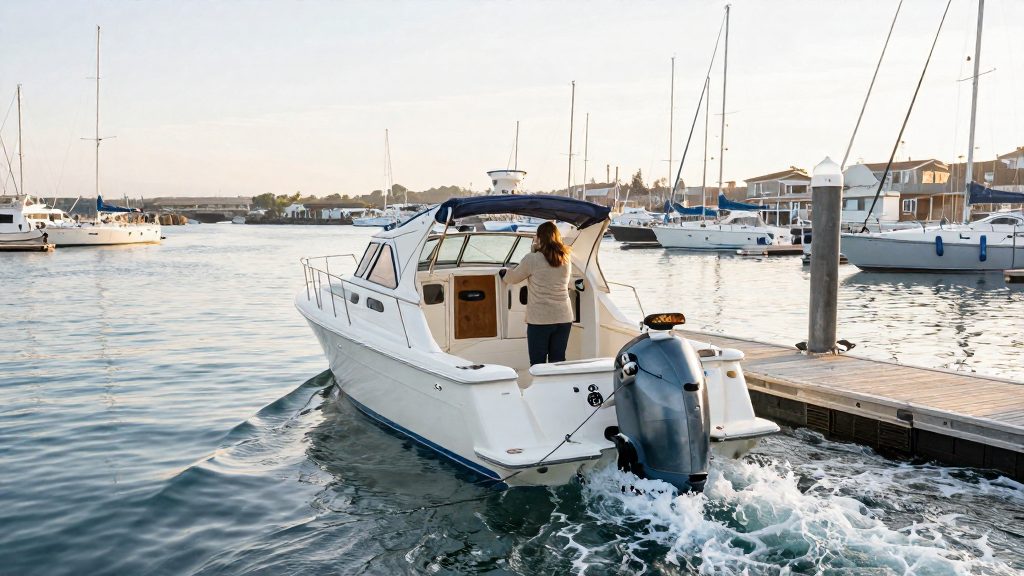
To dock a boat in a crosswind, approach at a steep angle into the wind or current, have fenders and lines ready, and stop a few feet from the dock with reverse. Secure the bow line first, then turn the wheel away from the dock and power ahead so the stern swings in. When the wind or current pushes the boat onto the dock, reverse the method: come in at a narrow angle or parallel to the dock, keep speed low, and let the push do much of the work. Practice matters more than any single angle, because wind strength and hull shape change how far a boat drifts at each engine speed.
Why do crosswinds make docking harder?
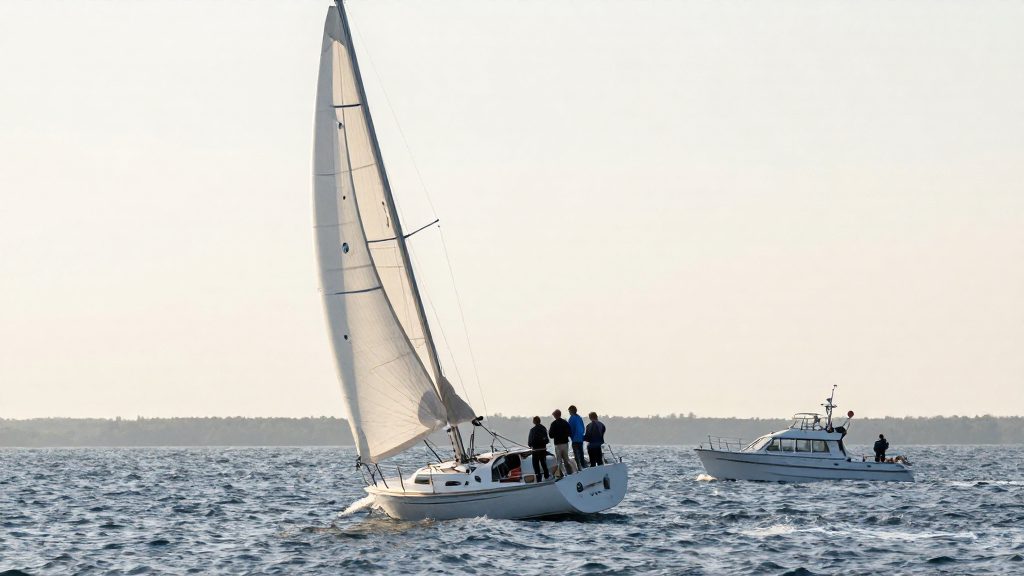
A crosswind acts on the whole profile of the boat above the waterline. The cabin, a canopy or the freeboard catch air, and that force pushes the boat sideways and makes it turn, not only drift. Outboards tend to pivot at the stern, so the bow can swing in a gust. Discover Boating’s guidance notes that high-sided cabin cruisers are pushed far more by the wind than low-profile boats, while boats with deep keels are least affected when their sails are down.
Current works differently. It moves water around the hull below the waterline, so the boat can be carried sideways over the bottom while the dock appears to stay still. A rudder only steers well when water flows past it, so a boat can look well positioned and still be drifting toward a piling. Wind has a similar trap at low speed: as headway falls, the wind has proportionally more effect on the boat’s path. This is why a boat that steers well at cruising speed can feel unresponsive at dock speed.
How do you read the wind and current before you approach?
Judge the wind at the dock itself, not only in open water. Discover Boating suggests that a flag on a flagpole gives a quick read of direction and rough speed. Without one, look at treetops along the shore or at other boats on moorings. For current, compare floating debris with fixed objects, watch for docklines that droop and are pulled in one direction, and look for ripples at pilings, which show both direction and strength.
Then check the marine forecast. Environment and Climate Change Canada (ECCC) defines a strong wind warning as wind of 20 to 33 knots, excluding gusts, and a storm warning as 48 to 63 knots. According to ECCC’s warning guidance (page dated 2014), strong wind warnings are issued primarily during the recreational or summer boating season, and the start and end dates vary by region. A forecast describes conditions over a marine area, so it cannot tell you exactly what a particular dock is experiencing. If a strong wind warning is in effect where you are, consider postponing the docking or moving to a more sheltered berth until it is lifted.
What should be ready before you approach?
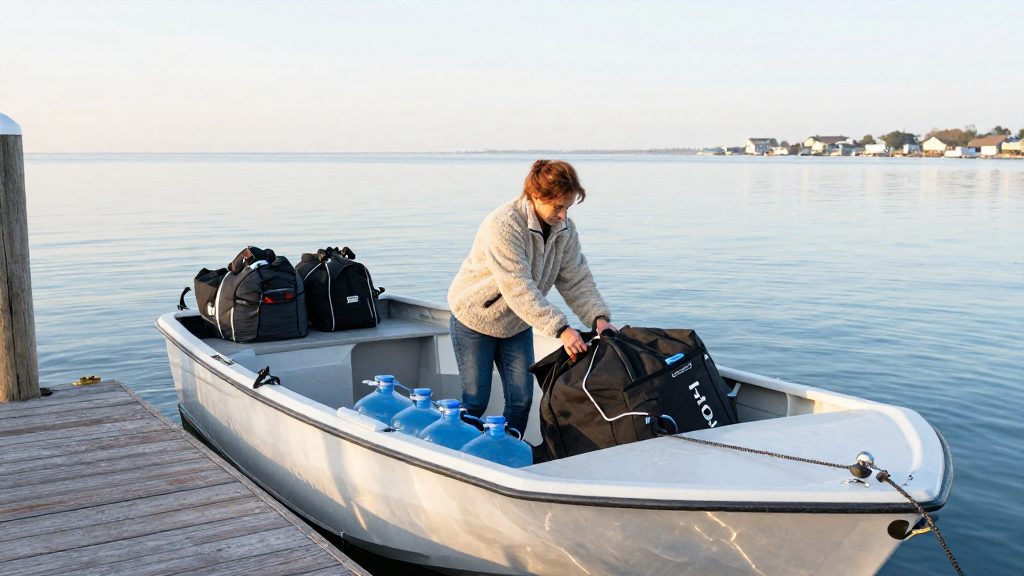
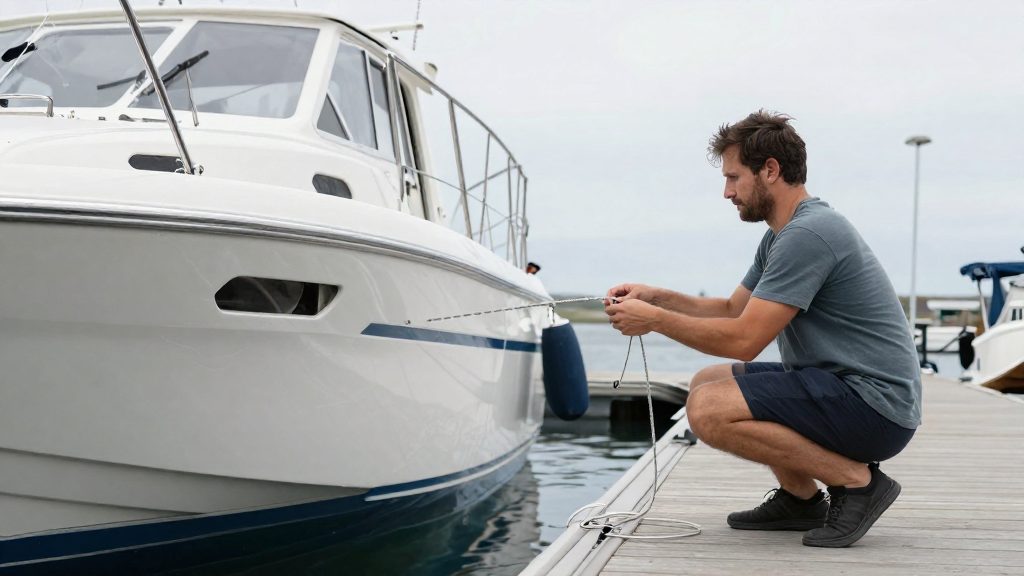
Put fenders out before the boat is near the dock, on the side that will meet the dock edge or a piling. One boat manufacturer’s technique guide advises choosing fender position according to exactly where the wind or current is coming from. Lay out the bow and stern lines so they run free. Never wrap a line around your hand, and do not leave a loose bight where it can catch a cleat or the propeller.
Agree on the plan before the engine starts. One person should be ready to step ashore with the bow line, another should handle the stern, and everyone should know the signal for stop and the signal for calling off the approach. If you can, test steering and gear response at low speed in open water first. Keep crew out of the path of lines and clear of the gap between hull and dock.
How do you dock with the wind or current pushing you off the dock?
When the wind or current pushes the boat away from the dock, or comes from ahead, the sequence most boating educators teach is this:
- Approach slowly at a steep angle, about 30 to 40 degrees to the dock, heading into the wind or current. The manufacturer’s guidance gives this range as a starting point, so adjust it for your boat after practice. A steep approach presents less of the hull to the wind and lets the flow slow the boat.
- A few feet from the dock, put the engine in reverse to stop the boat, then shift to neutral.
- Get the bow line ashore and secure it. This comes first because it holds the bow while the stern moves.
- Turn the wheel hard away from the dock and go forward. With the bow held, power ahead on that turn swings the stern in toward the dock.
- Make the stern line fast once the stern is close enough to reach.
Keep throttle movements small. The goal is a controlled swing, not a fast one. If the stern does not come in, reduce power, check that the bow line is holding, and try again rather than adding throttle.
When should you let the wind push you onto the dock?
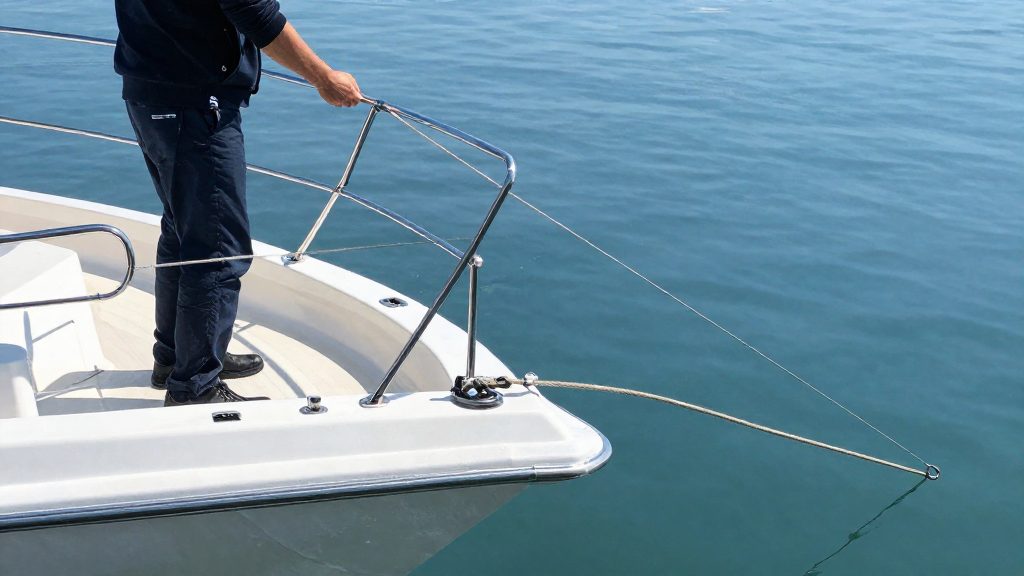
When the wind or current pushes toward the dock, or when there is no wind at all, come in at a narrow angle or parallel to the dock. Secure the bow line first and the stern second. Keep speed low and use the push to bring the boat in, rather than fighting it with power. Do not use your arms or legs to stop the boat against the dock, because a hand or foot caught between hull and dock can be crushed.
On a downwind dock, the best method is often to drift gently onto the dock rather than power in. A US boating magazine’s guidance on this technique notes that it depends on a skipper who has practised enough to judge how fast a given wind makes the boat drift. Deploy fenders and lines before arrival, because a drifting boat can arrive faster than expected.
How do you build the skill and learn your boat’s windage?
Practise in open water, away from docks and other boats. Learn which engine speed brings the boat close enough to the dock without being blown off, and note how the boat responds to reverse at different speeds. A boat with a tall canopy or a loaded deck will behave differently from the same boat empty, so record what you notice in different winds.
Windage is the area of the boat exposed to wind, and hull shape, freeboard and accessories all change it. Check your owner’s manual or the manufacturer’s documentation for handling notes, such as how the boat responds to reverse and whether a thruster changes the approach. If the documentation does not give guidance for your model, rely on your own observed behaviour rather than a figure taken from another boat.
What mistakes make crosswind docking go wrong?
The most common mistake is approaching too fast and then trying to stop the boat with a late reverse, which leaves the wind in control. A second is coming in parallel to a dock that is being pushed toward you by a strong wind, then powering in against the hull. A third is leaving lines unsecured until the boat is already drifting. Each of these comes from the same error: treating the wind as a fixed force rather than a changing one. Read the conditions again as you come in, and adjust the angle and speed as the boat responds.
Frequently asked questions
Do I need proof of competency to dock a boat in Canada?
If you operate a power-driven boat in Canada, you need proof of operator competency, and the Pleasure Craft Operator Card is the usual form of it. Transport Canada says the card does not expire. Non-residents may follow different rules depending on how long they stay and what boat they use, so check Transport Canada’s official pages for your situation.
Can one person handle a boat in a crosswind?
It is possible on a small, easy-to-handle boat in light wind, once you have practised. In stronger wind, a second person ashore or at the stern makes the bow and stern lines much easier to manage, and it is the safer choice.
What should I do if I miss the dock on the first attempt?
Do not force the approach or try to fend the boat off with your body. Put the engine in neutral, keep clear of lines and the dock edge, and go around in open water to reassess the wind and current before trying again.