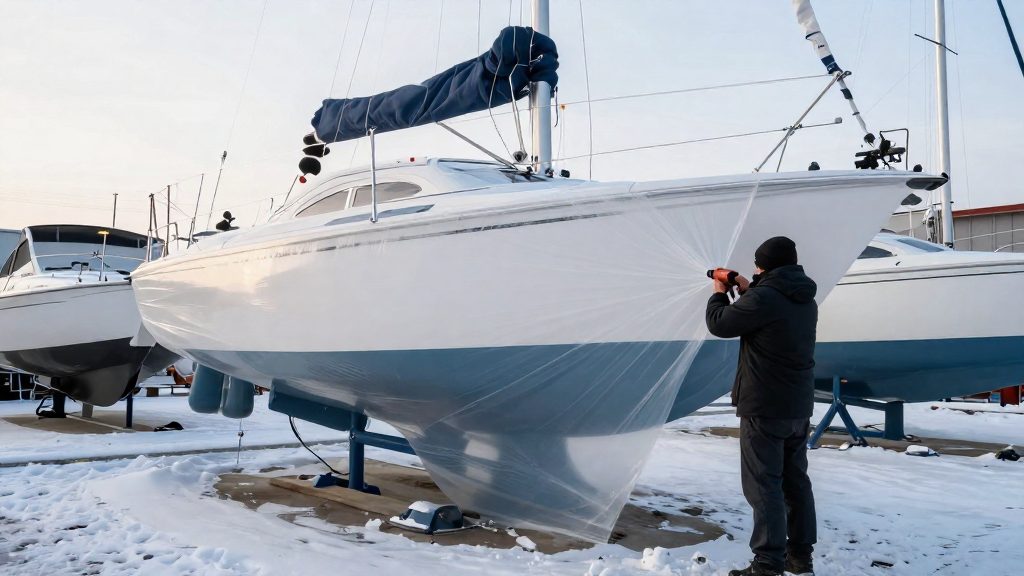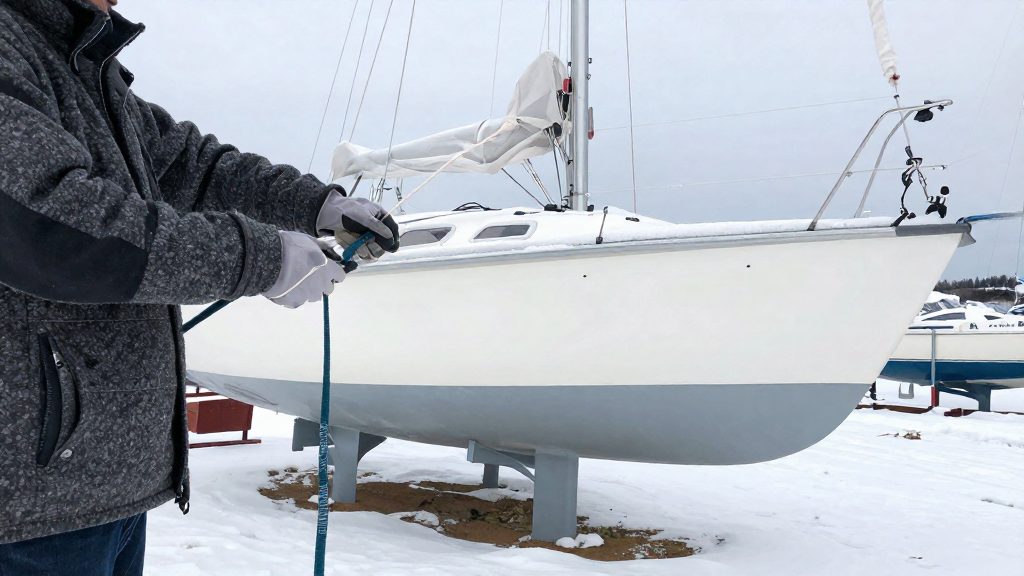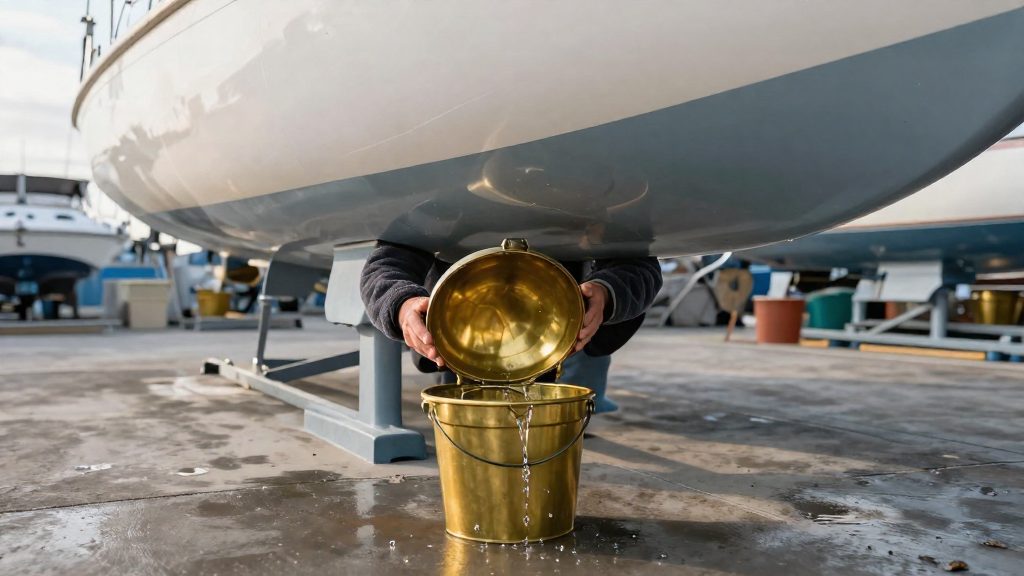
To drain boat plumbing before a freeze, empty every part of the system that can hold water, including the freshwater tank, supply lines, faucets, water heater, toilets and bilge pump. Then fill the freshwater system with non-toxic antifreeze made for boats and push it through each faucet until it appears at the outlet. Water left in any section can freeze and split housings and fittings, so the job must be complete rather than partial. The sequence below follows the winterizing guide published by Discover Boating (NMMA), a United States marine industry association, supplemented by Canadian retailer advice and Transport Canada maintenance guidance. Check each step against your manufacturer’s owner’s manual before you start.
Why does water left in plumbing damage a boat in a freeze?
Water expands as it turns to ice, and that expansion needs very little room to do damage. Water trapped in a faucet body, a pump head, a water heater tank, a toilet valve or a low point of a supply line can crack that component when it freezes. The damage is often invisible until spring, when the system is pressurized again and the leak appears, sometimes inside the bilge where it goes unnoticed for weeks. Water begins to freeze at 0 °C (32 °F), so any stretch of plumbing exposed to that temperature, even briefly, is at risk. Dead-end lines, long horizontal runs and fixtures that are hard to reach are easy to overlook, which is why the order of the steps matters as much as the antifreeze itself.
What do you need before you start draining?
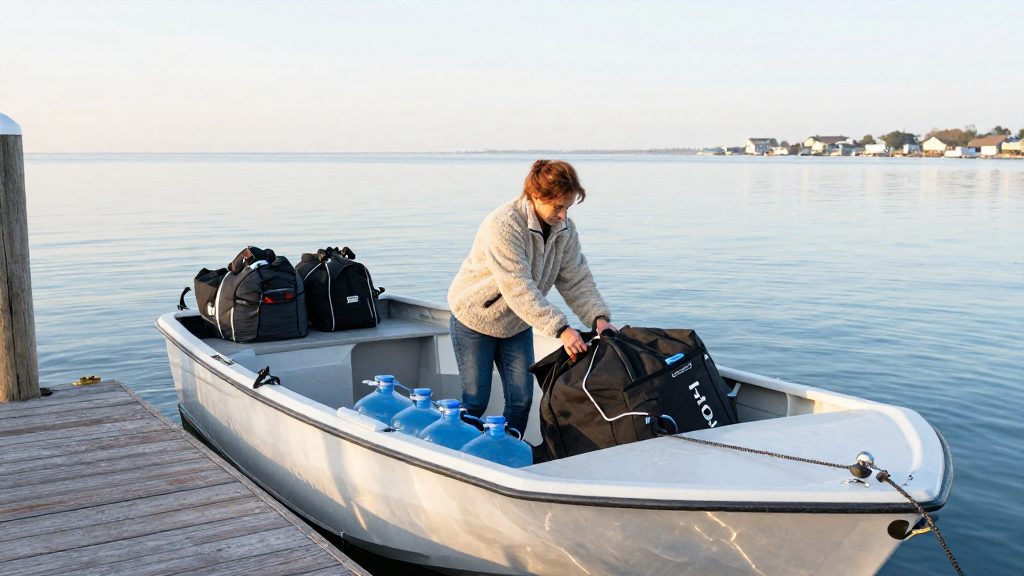
Gather your materials first so you are not interrupted halfway through the purge. You will need non-toxic antifreeze labelled for boat freshwater systems, a way to pump antifreeze through the pump and lines, a bucket and rags for drips, gloves and eye protection, and the owner’s manuals for the engine, water heater and pump. Antifreeze is a chemical product. Keep it in its original container, label any transfer container clearly and store it away from drinking-water containers.
Before you drain, inspect the hoses and lines. Transport Canada advises checking all hoses and lines for leaks or cracks as part of routine maintenance, according to its maintenance guidance (2026). A cracked line found in autumn is far easier to repair than one discovered after it has frozen.
The official sources consulted do not give temperatures, quantities or antifreeze volumes for a given boat. The amount you need depends on the capacity of your tank and the length of your lines, so the manufacturer’s documentation is the reference for amounts.
How do you drain the freshwater tank and lines?
Start by emptying the freshwater tank. Open all faucets and let them run until the tank is dry, then close them. Add non-toxic antifreeze to the tank, as Discover Boating (NMMA) describes.
Next, purge the lines, beginning with the faucet physically farthest from the tank. Open it and wait until antifreeze comes out, close it, then repeat with the next-farthest faucet. Continue until antifreeze reaches every outlet. Starting at the far end ensures that the antifreeze travels the full length of each line rather than stopping at the nearest fixture, which would leave water trapped in the long runs.
Keep the pump supplied while you work. A pump that runs dry can be damaged, so watch the level in the tank and follow the pump manufacturer’s instructions for running it.
What should you do with the water heater and filters?
Run both hot and cold faucets so that the antifreeze passes through the water heater, as Discover Boating (NMMA) describes. If the heater can be bypassed, drain it separately instead, following the manual. Before opening any heater drain, let the unit cool and relieve pressure as the manufacturer directs, because hot water and steam can cause burns.
The Big, a Canadian marine retailer, recommends removing water filters and heaters so that cold conditions cannot damage them. Where the manufacturer allows it, take out the filter cartridges and store them dry until spring.
What about the heads and holding tanks?
Pump out the holding tanks at a pump-out station before adding antifreeze. Then pump antifreeze through the head or heads, following the manufacturer’s procedure, until the bowl and discharge line are clear of water. Remove and empty any portable marine sanitation device, and store it empty and dry. Use a pump-out facility rather than discharging holding tank contents into the water, and keep the sanitation system closed while you work.
Which antifreeze should you use, and why does it matter?
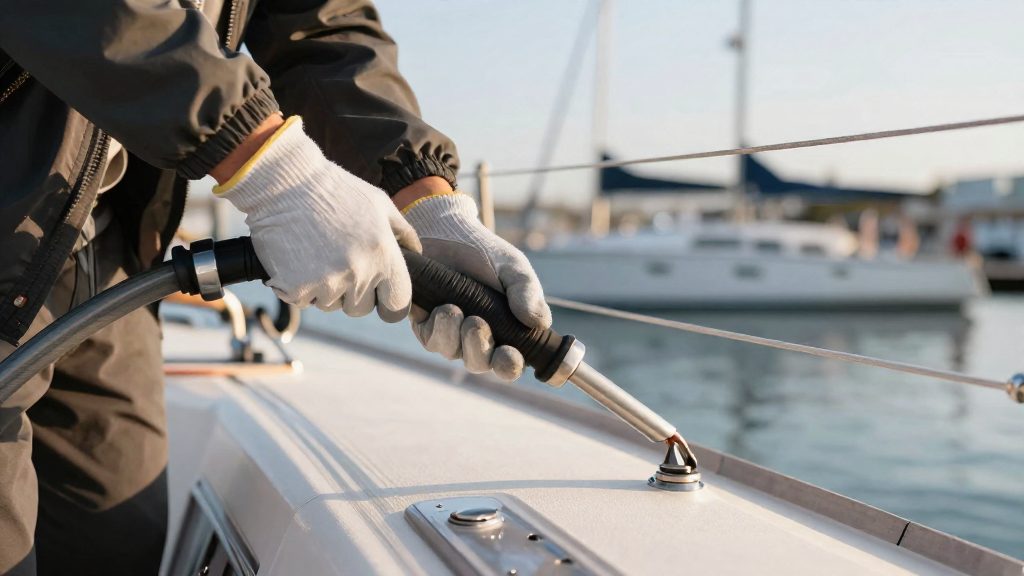
Use non-toxic antifreeze made for boats in the freshwater system. Both Discover Boating (NMMA) and The Big specify a non-toxic product designed for boat use. The sources consulted do not recommend automotive antifreeze for a boat’s drinking-water lines, so stick to products labelled for marine use.
The reason for this choice is practical. The potable system will be used again in spring, and any antifreeze left in it must be flushed out before anyone drinks from it. A product that is not designed for potable systems adds a risk that a non-toxic marine product is meant to reduce.
The engine cooling system is a separate matter. Discover Boating (NMMA) describes an environmentally safe antifreeze for inboard engines, and The Big advises using antifreeze specifically designed for the engine. Do not put the drinking-water product into the engine cooling circuit, and do not put engine coolant into the potable system.
How do you winterize the engine cooling system?
Treat the engine cooling system on its own, as a separate job from the plumbing. For an inboard engine, Discover Boating (NMMA) advises bringing the engine up to operating temperature before running antifreeze through it, because the thermostat can block flow to some cooling passages when the engine is cold. Run the engine until antifreeze comes out of the exhaust ports. Follow the engine manufacturer’s procedure for the connections and the flow rate.
Safety comes first. Start the engine only when the intake is supplied with antifreeze mix, and never run it dry, since that can damage the water pump. Run the engine in open air, never in an enclosed space, because exhaust gases are dangerous. Keep hands, clothing and tools away from moving parts and hot surfaces. Outboards and sterndrives follow a different routine, and the sources consulted do not describe it in detail, so the manufacturer’s documentation is the reference for those engines.
When and how do you return the system to service?
Return the plumbing to service only once the risk of freezing has passed for your location, and do not rely on a fixed calendar date. Before refilling the system, remove the winter antifreeze from the potable lines as the manufacturer directs. Transport Canada’s sample maintenance schedule recommends that owners flush and chlorinate the freshwater system, and it also calls for checking all freshwater lines and connections for tightness (2011). Reinstall the filters and water heater only after the flush is complete, and check every fitting for drips once the water is running.
Do not use the water for drinking or cooking until the flushing and sanitizing steps are finished. The official sources consulted do not give flushing volumes or chlorine concentrations, so follow the manufacturer’s sanitizing procedure exactly. If anything seems wrong, such as a fitting that weeps or a pump that struggles, stop and check the manual rather than forcing the system.
Frequently asked questions
Can I skip draining if the boat is stored in a heated building?
The official sources consulted do not address heated storage. Whether the plumbing is at risk depends on whether the space stays above 0 °C (32 °F) at all times. If you are not certain, drain the system anyway and check the manufacturer’s guidance.
Should I drain the fuel tank as part of winterizing?
Transport Canada’s sample maintenance schedule asks owners to keep fuel tanks free of scale, dirt and water. The sources consulted do not give a fuel tank drain-down procedure, so follow the engine manufacturer’s storage guidance.
Can I use compressed air instead of antifreeze?
The sources consulted do not describe air blow-out as a substitute for antifreeze. Ask the manufacturer before using compressed air in any part of the system.
Do I need to winterize if the boat is stored for only a few weeks?
The sources consulted do not set a storage duration threshold. The deciding factor is whether temperatures can reach freezing where the boat is kept, so check local forecasts and the manufacturer’s advice.