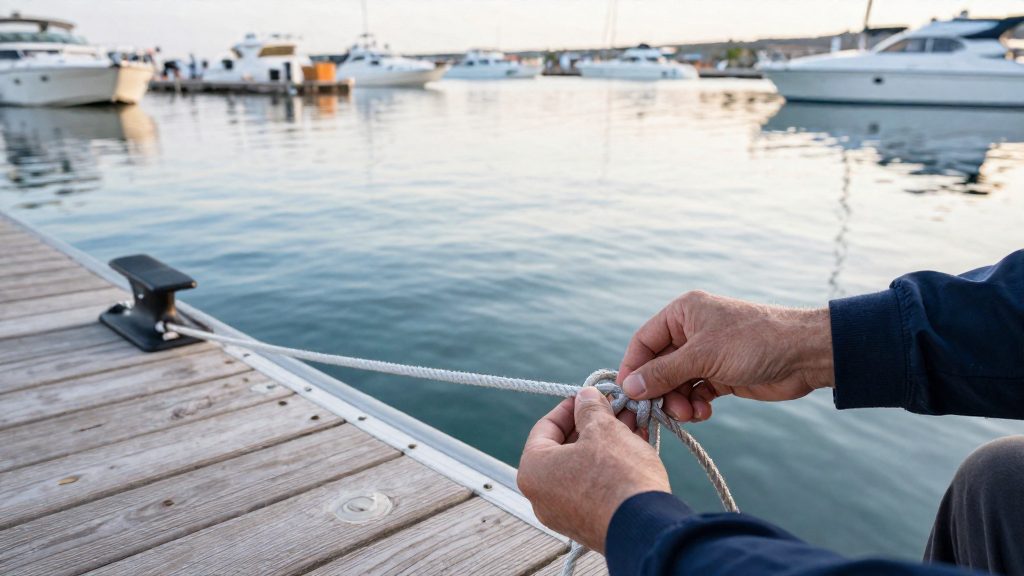
The bowline forms a fixed loop at the end of a line. It holds under load without slipping, yet it can still be untied after bearing a strain, which is why it is a standard choice for tying a boat to a dock or cleat. To tie it, make a small loop, pass the working end up through it, wrap that end around the standing part, feed it back down through the loop, and pull both ends to set the knot. Check the finished knot before you rely on it, because the most common error reverses the last tuck.
Why is the bowline the go-to mooring knot?
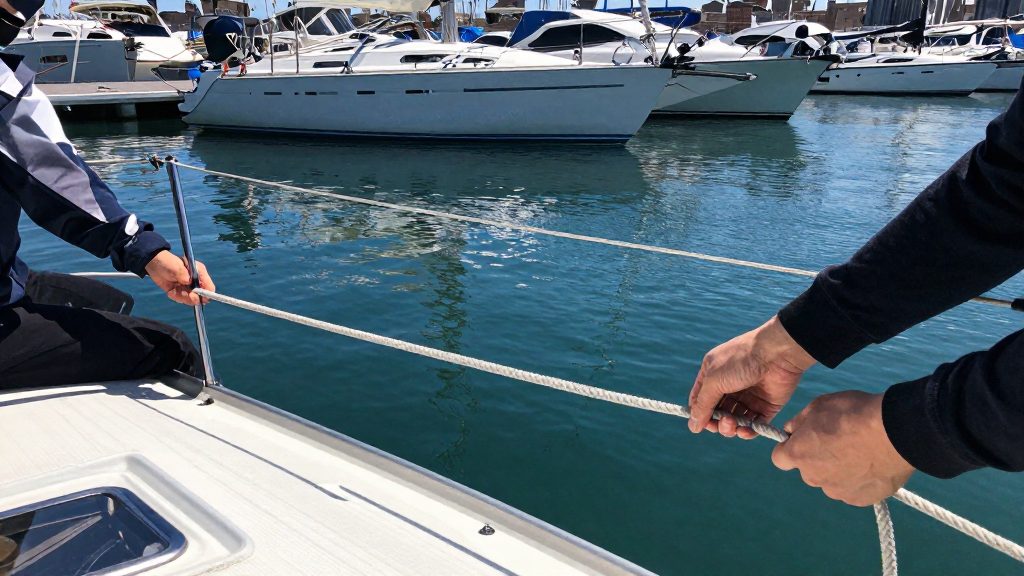
Discover Boating (NMMA), in a guide dated 2024-10-29, describes the bowline as reliable under tension, meaning it will not slip or come untied, and notes that it is notoriously easy to untie even after bearing a load. Those two properties matter at a dock. A mooring line is loaded for long periods, and the crew then needs to release the boat quickly, often with wet or cold hands. The same guide lists the knot’s boating uses as tying a boat to a dock or cleat, securing an anchor line, fastening sail halyards and sheets, and rescue. For mooring, the bowline is valued for the combination of a secure grip and a quick release.
How do you tie a bowline step by step?
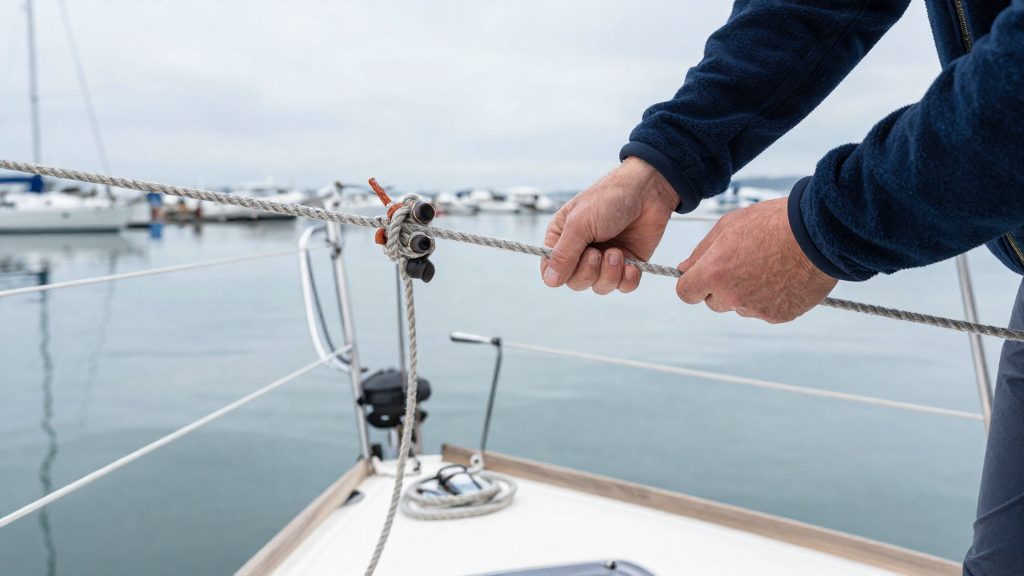
The sequence below follows the five steps set out by Discover Boating (NMMA) (2024-10-29). Three terms recur. The standing part is the long section of line that carries the load. The working end is the free end you tie with. The loop is the fixed eye the knot creates.
- Make a small loop near the end of the rope. The working end passes under the standing part to form it.
- Pass the working end up through the loop, from underneath.
- Wrap the working end around the standing part.
- Feed the working end back down through the loop, in the opposite direction to the first pass.
- Dress the knot so that its parts lie neatly, then pull the standing part and the working end to tighten.
Size the loop with care. It should hold its shape and stay secure, but it should not be cinched so hard that it becomes difficult to undo. A traditional memory aid is the rabbit-and-tree story: the rabbit comes up out of the hole, goes around the tree, and goes back down the hole. It maps onto steps 2 to 4. Practise the sequence with a spare piece of line on a calm day, so that you can tie it reliably on a wet dock in wind.
How do you avoid the cowboy bowline?
Sailboat-Cruising.com (2026), written by Dick McClary, an RYA Yachtmaster Offshore instructor, identifies the most common bowline mistake as the ‘cowboy’ or ‘Dutch’ bowline, in which the final tuck is reversed. The result looks similar at first glance, but it weakens the knot and can let it slip under load, which is exactly the failure you cannot afford at a mooring. A practical habit is to compare each finished knot with a known-good bowline, checking that the working end lies alongside the standing part in the correct way. If you are not sure, untie it and tie it again rather than trusting it.
How secure is a bowline on a dock cleat or piling?
The bowline is secure in use, but it is not free of cost to the line itself. Sailboat-Cruising.com (2026) notes that, like all knots, the bowline reduces the line’s breaking strain. The author estimates the average loss at about 35 percent in braided polyester, and considerably more in Dyneema. Because this is one author’s estimate rather than a published test, the official sources consulted do not specify a value for your line. Consult the line manufacturer’s documentation for its rated strength and any knot reduction, and choose line and a mooring arrangement with a margin that suits your boat.
For a critical mooring, add a backup. Sailboat-Cruising.com (2026) suggests either a stopper knot, such as a figure-eight, or a second bowline tied at the very end of the line, beyond the first knot. Dress the knot and set it with a sharp tug before the boat is left unattended. Protect the line from chafe where it passes over a fairlead, a rail or a piling by using a chafe guard or an extra turn. Inspect the knot and the line after every change in weather or tide, and after a period of wet or freezing conditions, because a stiff or swollen rope is harder to untie.
When should you choose another knot?
Choose another arrangement when the line must be adjusted under load or tightened often, because the bowline is not designed to be eased repeatedly while it bears weight. On a cleat that will be adjusted, a cleat hitch is the usual choice, since it locks the line off once it is made fast. On a piling, a round turn followed by two half hitches is a common alternative, and a figure-eight stopper can be added to either. Use a bowline when you need a loop that holds steady and releases cleanly, not as a substitute for a proper cleat arrangement.
Safety comes first in every case. Never stand in the bight of a line that is under load, and keep a knife within reach in case a loaded knot must be cut in an emergency. Replace any line that shows chafe, cuts or heavy wear, because no knot can compensate for a weakened rope. If wind or current is building, add lines or adjust the mooring rather than relying on a single tie.
Frequently asked questions
Are there other bowline variations I should know about?
Discover Boating (NMMA) (2024-10-29) lists the double, running and water bowlines as variations. The official sources consulted do not specify which variation suits mooring, so learn the standard bowline first.
Can I tie a dinghy to a tree with a bowline?
Only as a short, supervised tie in calm conditions. Protect the trunk from chafe, check the knot often, and do not leave the boat secured to a tree when weather or water levels may change.